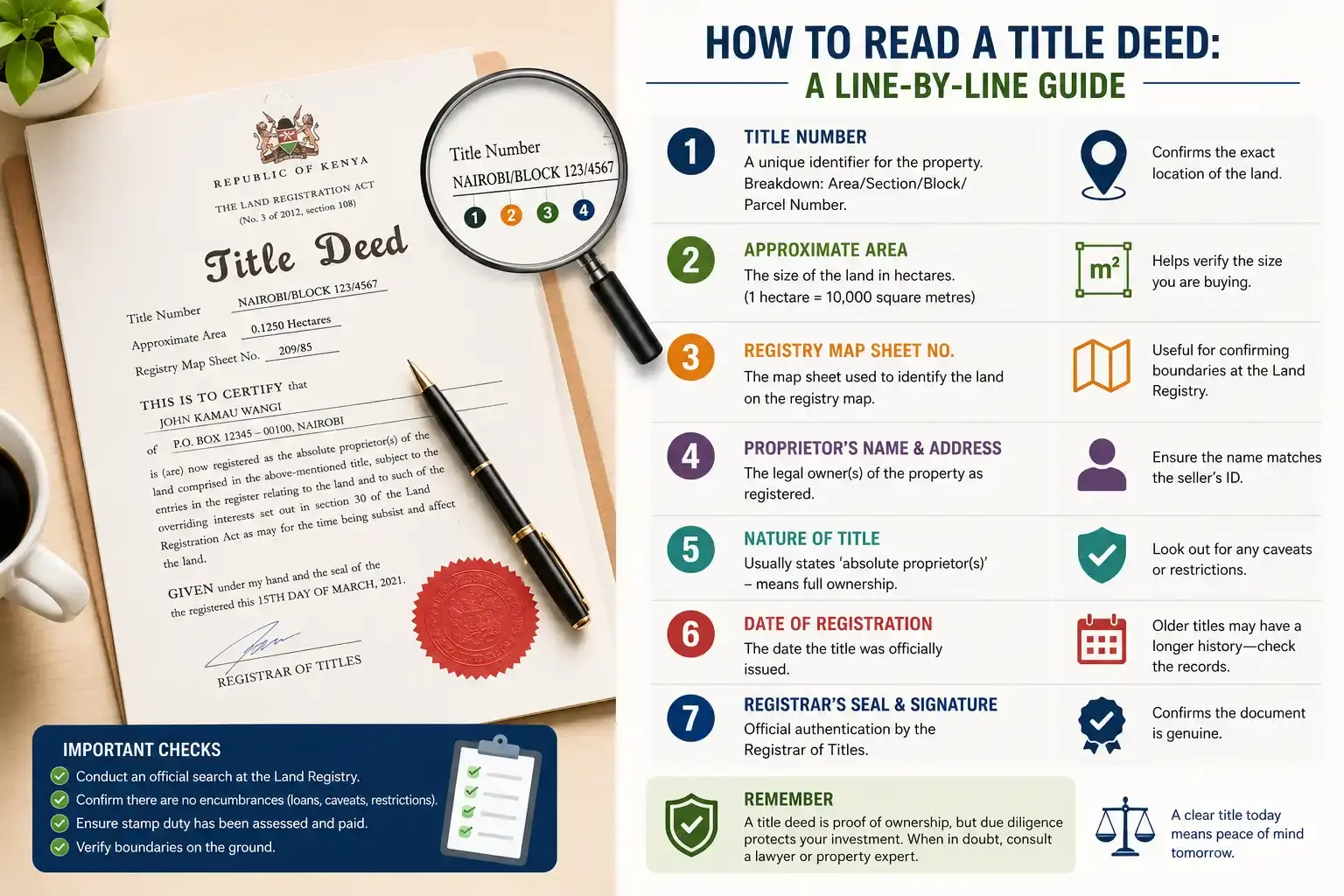
A title deed is the single most important document in any Kenyan property transaction — yet many buyers glance at it briefly, confirm it "looks official," and move on, without actually understanding what each section means or how to spot something wrong. Learning to read a title deed properly is one of the most valuable due diligence skills a property buyer can develop.
What a Title Deed Actually Is
A title deed is the official legal document proving ownership of land in Kenya, issued and registered by the Ministry of Lands. Depending on the type of ownership, you may encounter slightly different document types — a title deed for freehold land, or a certificate of lease for leasehold land — though both serve the same fundamental purpose of documenting registered ownership.
Breaking Down Each Section
1. Title Number / Parcel Number
This is the unique identifier for the specific piece of land, used to reference it in any official search, transaction, or registry record. This is the number you'll use when conducting an independent land search — always verify it matches exactly what's on the document and what the seller has told you, with no discrepancies.
2. Registration Section and District
This indicates where the land is registered within Kenya's land registry system, and should correspond logically to the land's actual physical location. A mismatch between the stated registration location and the land's actual location is worth investigating carefully.
3. Proprietor's Name
This is the legally registered owner of the land. This name must match the identity of the person you're transacting with — if you're buying from someone other than the named proprietor, there needs to be clear, verifiable legal documentation explaining their authority to sell (power of attorney, letters of administration for an estate, or similar).
4. Size/Area of Land
The registered size of the parcel, typically in hectares or acres. This should match what a physical survey confirms on the ground — significant discrepancies between the documented size and the actual physical boundaries are a serious red flag warranting further investigation before proceeding.
5. Nature of Title (Freehold or Leasehold)
This section specifies whether the land is held freehold (indefinite ownership) or leasehold (ownership for a fixed term, commonly up to 99 years for many leasehold parcels, though terms vary). For leasehold land, confirm the remaining lease term — a leasehold nearing expiry carries different considerations than one with decades remaining.
6. Encumbrances Section
This is one of the most critical sections to review carefully. It records any charges, caveats, restrictions, or other legal interests registered against the land — including outstanding mortgages, court disputes, or claims by other parties. A property with unresolved encumbrances can be significantly riskier to purchase, and any listed encumbrance should be clarified and, where necessary, cleared before completing a purchase.
7. Date of Registration
This shows when the current registration was recorded. While not inherently a red flag on its own, a very recent registration date on land being resold almost immediately can sometimes warrant additional questions about the transaction history.
8. Registrar's Signature and Official Seal/Stamp
Legitimate title deeds carry an official registrar's signature and seal. While replicating these convincingly is unfortunately possible with sophisticated fraud, their absence or an unusual appearance compared to genuine samples is worth flagging immediately.
Red Flags to Watch For When Reviewing a Title Deed
- Mismatched names between the title deed and the seller's identification documents, without clear legal explanation
- Unclear or unresolved encumbrances that the seller can't clearly explain or resolve
- Size discrepancies between the documented area and what a physical survey confirms
- Poor print quality, inconsistent fonts, or unusual formatting compared to genuine title deed samples
- Reluctance from the seller to provide the original document for inspection, offering only photocopies or scans
- A registration history that doesn't align with the seller's account of how they acquired the property
Why Reading the Deed Yourself Isn't Enough
Even a carefully reviewed title deed should never be the only verification step. An independent land search through Ardhisasa (or via the Ministry of Lands) cross-checks the document against the official government record — confirming the registered owner, current encumbrances, and any disputes match what's shown on the physical deed in front of you. Discrepancies between the physical document and the official registry record are a serious warning sign. For a broader look at common fraud patterns beyond the title deed itself, see our guide on how to spot a fraudulent land sale in Kenya.
Title Deed vs Certificate of Lease: Know the Difference
Buyers sometimes assume all Kenyan land ownership documents are simply called "title deeds," but leasehold land is technically documented via a certificate of lease rather than a title deed in the strictest sense, though the terms are often used interchangeably in casual conversation. Understanding which applies to your specific property — and what it means for your ownership rights and any renewal requirements — is an important part of reviewing the document properly.
Practical Tips for Reviewing a Title Deed
- Request the original document, not just a photocopy or scan, and inspect it in person where possible
- Cross-check every detail — name, parcel number, size — against the seller's identification and other transaction documents
- Conduct an independent registry search rather than relying solely on the physical document
- Engage a qualified property lawyer to review the document alongside you, particularly for higher-value transactions
- Ask direct questions about any encumbrance listed, and don't proceed until it's clearly explained and, if necessary, resolved
Buy With Verified Documentation Through Masion
Understanding a title deed is a critical skill, but working with verified listings from the start reduces your risk considerably. At Masion, we list properties with documented, verifiable ownership records, helping you invest with greater confidence.
Browse verified property listings at masion.co.ke.
This article is for general informational purposes and does not constitute legal advice. Always consult a licensed advocate to review any title deed before completing a property transaction.
FAQs
1. What's the most important section of a title deed to check? The encumbrances section deserves particularly careful attention, since it reveals any existing charges, disputes, or restrictions registered against the land that could affect your ownership.
2. Is a title deed the same as a certificate of lease? Not technically — leasehold land is documented via a certificate of lease rather than a title deed in the strictest sense, though the terms are often used interchangeably in everyday conversation. Understanding which applies to your property matters for your ownership rights.
3. Can I trust a title deed just because it looks official? No — sophisticated fraud can replicate official-looking documents, which is why an independent land search through Ardhisasa or the Ministry of Lands is essential to cross-check the physical document against the official registry record.
4. What should I do if the title deed shows an encumbrance? Ask the seller to clearly explain the encumbrance and, where necessary, ensure it's resolved (such as a mortgage being cleared) before completing the purchase — don't proceed until you fully understand what it means for your ownership.
5. Does the size on a title deed always match the actual land on the ground? It should, but discrepancies do occur and are a serious red flag. Commissioning an independent survey to confirm the physical boundaries match the documented size is an important verification step.
6. Do I need a lawyer to read a title deed, or can I review it myself? While understanding the basic sections yourself is valuable, engaging a qualified property lawyer to review the document alongside you is strongly recommended, particularly for higher-value transactions, given the legal and financial stakes involved.
A little more clarity
Frequently asked questions
What does this article cover?
A title deed is the single most important document in any Kenyan property transaction — yet many buyers glance at it briefly, confirm it "looks official," and move on, without actually understanding what each section means or how to spot something wrong. Learning to read a title deed properly is one of the most valuable due diligence skills a property buyer can develop.
How can I find properties related to my requirements?
Browse the property listings and filter by location, price, and property type. You can also use Request a Property to share your requirements and receive matching suggestions.
How can I ask about a property?
Open the property page to review its details and contact the listing agent using the enquiry options shown there. Confirm availability and arrange a viewing with the agent.

Join the conversation
Comments
Looking for a property?Get help with a request tailored to your location and budget.
No comments yet. Share a thought or ask a question above.