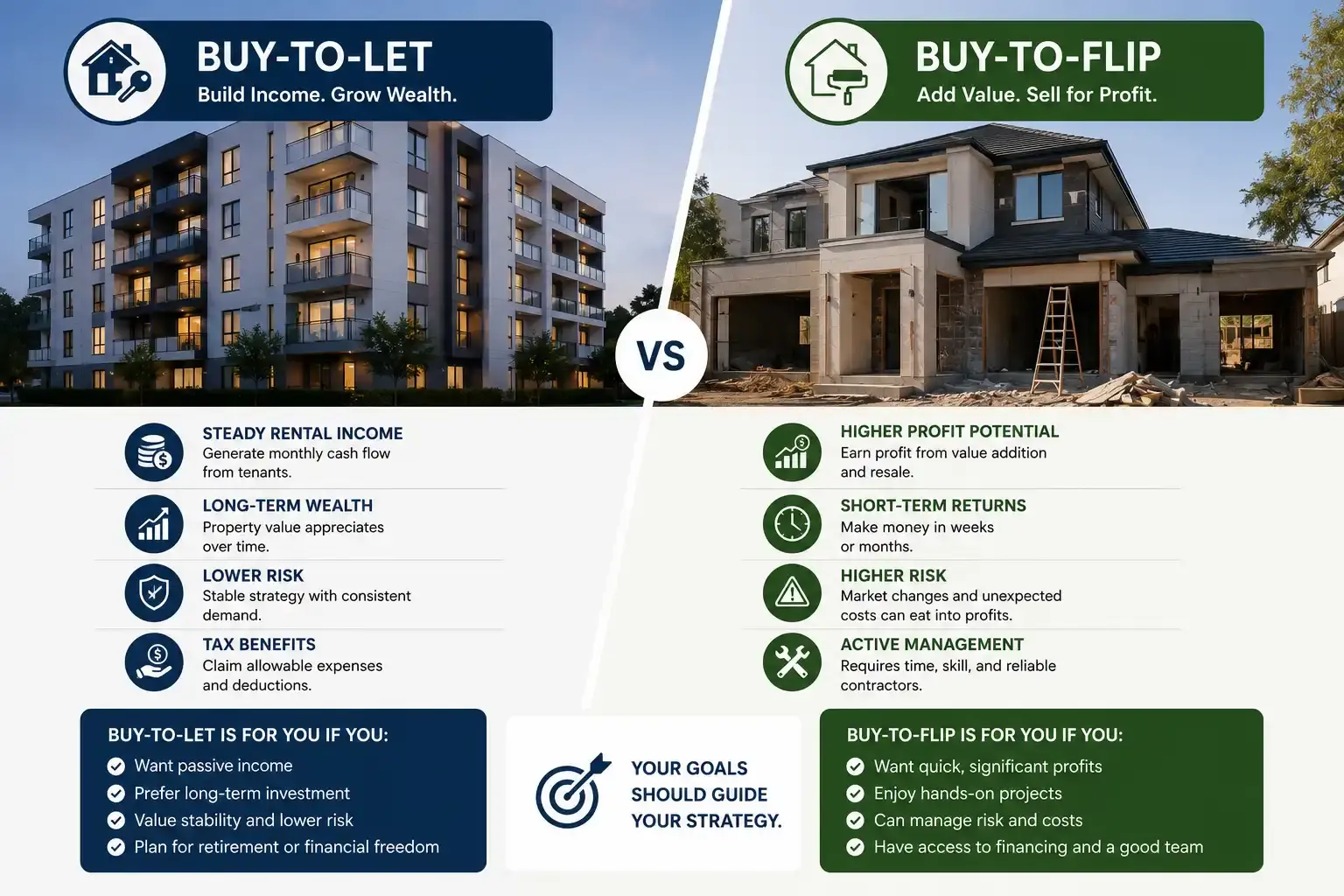
Two of the most common property investment strategies — buy-to-let and buy-to-flip — pursue fundamentally different goals, timelines, and risk profiles. Confusing the two, or applying the wrong strategy to a specific property, is one of the more common mistakes new property investors make. Here's a clear comparison to help you decide which approach actually fits your goals, capital, and risk tolerance.
What Is Buy-to-Let?
Buy-to-let means purchasing a property specifically to rent it out, generating ongoing monthly rental income while (ideally) also benefiting from long-term capital appreciation. It's a longer-term, income-focused strategy built around holding the property for years, not months.
What Is Buy-to-Flip?
Buy-to-flip (or "flipping") means purchasing a property — often one priced below market value due to needed renovation, distressed sale circumstances, or an off-plan opportunity — improving or simply holding it briefly, then reselling for a profit relatively quickly, typically within months to a couple of years rather than a long-term hold.
Comparing the Two Strategies
Time horizon:
- Buy-to-let: Long-term, typically years to decades
- Buy-to-flip: Short-term, typically months to two years
Primary return source:
- Buy-to-let: Ongoing rental income, plus gradual capital appreciation over time
- Buy-to-flip: A single lump-sum profit realized at resale
Capital requirements:
- Buy-to-let: Significant upfront capital, but income helps offset costs (or a mortgage) over time
- Buy-to-flip: Requires enough capital to purchase, renovate, and carry the property (including any financing costs) until resale, without rental income offsetting these costs along the way
Risk profile:
- Buy-to-let: Lower short-term risk, but exposed to tenant vacancy, maintenance costs, and market softening over the holding period
- Buy-to-flip: Higher short-term risk — renovation cost overruns, market timing (needing to sell into a favorable market), and holding costs if resale takes longer than expected
Involvement required:
- Buy-to-let: Ongoing, though manageable through a property manager — tenant relations, maintenance coordination, rent collection
- Buy-to-flip: Intense but concentrated — significant hands-on involvement during renovation and sale, then no ongoing responsibility once sold
Tax considerations:
- Buy-to-let: Rental income is subject to income tax; property held long-term may benefit from more favorable capital gains treatment depending on holding period and specific circumstances
- Buy-to-flip: Profit from resale is generally subject to Capital Gains Tax (currently 15% on net gain), and frequent flipping may in some cases be treated as a trading activity for tax purposes rather than a capital gain — worth clarifying with a tax advisor given the specifics of your situation
Which Suits Different Investor Profiles?
Buy-to-let tends to suit:
- Investors seeking steady, ongoing passive income rather than a single payout
- Those with a longer investment horizon and less urgency to realize returns quickly
- Investors comfortable with (or willing to outsource) ongoing property and tenant management
- Those prioritizing portfolio stability over higher-risk, higher-reward short-term plays
Buy-to-flip tends to suit:
- Investors with strong market knowledge and the ability to accurately assess renovation costs and resale value
- Those with sufficient capital to fully fund a purchase and renovation without relying on rental income to offset costs along the way
- Investors comfortable with more concentrated, hands-on involvement over a shorter, intense period
- Those seeking a faster return on capital to redeploy into subsequent projects
Key Risks to Understand for Each
Buy-to-let risks:
- Extended vacancy periods between tenants, reducing actual annual yield below projected figures
- Maintenance and repair costs eating into net rental income over time
- Difficult or non-paying tenants, and the time/cost involved in resolving disputes
- Market softening reducing achievable rent relative to initial projections
Buy-to-flip risks:
- Renovation costs exceeding initial budget, common enough to warrant building in a meaningful contingency
- Market conditions shifting unfavorably between purchase and planned resale
- Longer-than-expected time to sell, increasing holding costs (financing, rates, security) without any offsetting rental income
- Overestimating the property's post-renovation resale value relative to what buyers are actually willing to pay
Can You Combine Both Strategies?
Yes — some investors use a hybrid approach: purchasing a property below market value, renting it out for a period to generate income and let the market appreciate, then selling once conditions are favorable rather than committing rigidly to a pure buy-to-let or buy-to-flip timeline from the outset. This flexibility can reduce risk compared to a strict flip timeline while still capturing appreciation more actively than a purely passive long-term hold.
Questions to Ask Before Choosing
- Do I need income now, or am I optimizing for a future lump sum? This alone often points clearly toward one strategy or the other.
- How much capital can I commit without relying on rental income to offset costs? Flipping requires this buffer; buy-to-let doesn't as urgently.
- How much hands-on involvement am I realistically able or willing to provide? Both require effort, but at very different points in the timeline.
- What's my risk tolerance for a shorter, more concentrated bet versus a longer, steadier one?
- Do I have — or can I access — strong knowledge of renovation costs and resale values in my target area? This matters far more for flipping than for buy-to-let.
Explore Investment Properties with Masion
Whether you're building a rental portfolio or looking for your next flip opportunity, Masion lists verified properties across Kenya to help you find the right fit for your specific investment strategy.
Browse investment properties at masion.co.ke.
This article is for general informational purposes and does not constitute financial or tax advice. Consult a licensed financial advisor for guidance specific to your situation.
FAQs
1. Which is more profitable: buy-to-let or buy-to-flip? Neither is universally more profitable — it depends on execution, market timing, and capital availability. Buy-to-let offers steadier, longer-term returns, while buy-to-flip offers a potentially larger single payout but with higher short-term risk.
2. How much capital do I need to start flipping property in Kenya? Enough to cover the purchase price, renovation costs, and all holding costs (financing, rates, security) until resale — without relying on rental income to offset these costs along the way, unlike a buy-to-let purchase.
3. Is buy-to-let a safer strategy than flipping? Generally considered lower short-term risk, since it doesn't depend on accurately timing a single resale, though it carries its own ongoing risks like vacancy periods and maintenance costs over a longer holding period.
4. Do I pay different taxes on buy-to-let income versus flipping profit? Yes, generally — rental income is subject to income tax, while flipping profit is typically subject to Capital Gains Tax, though frequent flipping may in some cases be treated differently for tax purposes. Consult a tax advisor for guidance specific to your situation.
5. Can I switch a property from a flip to a rental if I can't sell it quickly? Yes, this is a common contingency plan — renting out a property that hasn't sold as quickly as hoped can help offset holding costs while waiting for better market conditions to resell.
6. What skills matter most for successful flipping versus buy-to-let? Flipping benefits most from strong renovation cost estimation and resale market knowledge, while buy-to-let benefits more from steady property and tenant management, whether handled personally or through a property manager.
A little more clarity
Frequently asked questions
What does this article cover?
Two of the most common property investment strategies — buy-to-let and buy-to-flip — pursue fundamentally different goals, timelines, and risk profiles. Confusing the two, or applying the wrong strategy to a specific property, is one of the more common mistakes new property investors make. Here's a clear comparison to help you decide which approach actually fits your goals, capital, and
How can I find properties related to my requirements?
Browse the property listings and filter by location, price, and property type. You can also use Request a Property to share your requirements and receive matching suggestions.
How can I ask about a property?
Open the property page to review its details and contact the listing agent using the enquiry options shown there. Confirm availability and arrange a viewing with the agent.


Join the conversation
Comments
Looking for a property?Get help with a request tailored to your location and budget.
No comments yet. Share a thought or ask a question above.