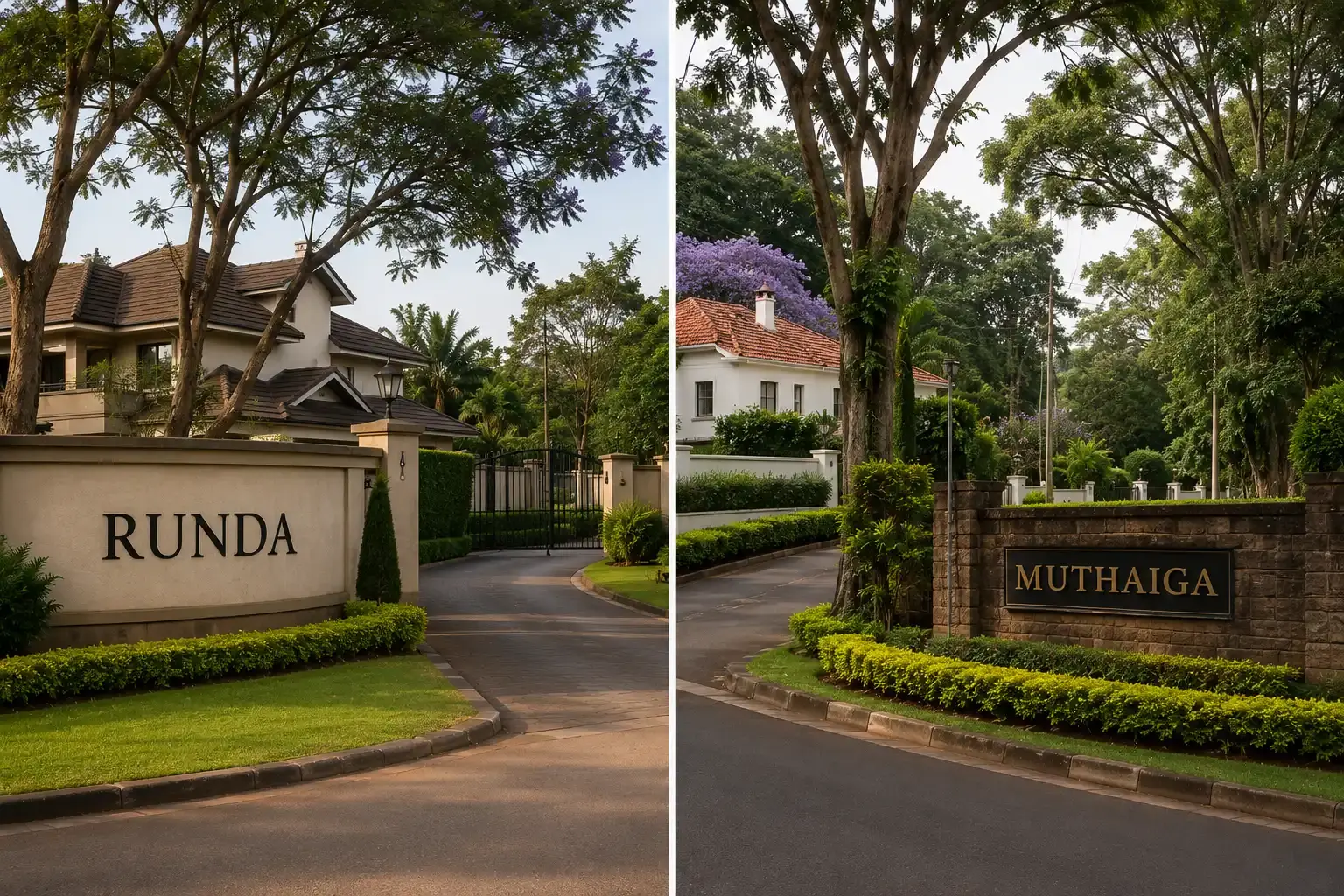
Runda and Muthaiga occupy a category of their own in Nairobi's property market — both along the prestigious Kiambu Road corridor, both home to diplomats, senior officials, and Kenya's established elite, and both consistently ranked among the country's top-performing suburbs for price appreciation. But despite their shared status, they're genuinely different propositions for a buyer, shaped by scale, history, and market structure. Here's how they compare.
Scale and Character
Runda is a single, large, professionally managed gated estate comprising thousands of homes — effectively a small, self-contained city within Nairobi. Its scale gives it a stable, broad owner base spanning professionals, diplomats, UN families, and senior corporate executives, and creates a genuinely deep, liquid property market with consistent buyer demand.
Muthaiga is smaller and more tightly held. It's Nairobi's most historically prestigious old-money address — home to diplomats, senior government officials, and the country's long-established elite — with a discreet character that international buyers and diaspora Kenyans sometimes overlook in favor of the more prominently marketed Runda. Its secondary market rarely produces oversupply, and owner turnover is notably low, reflecting how tightly the community holds onto its properties.
Price Comparison
Both suburbs command genuinely premium pricing, though sources show some variation depending on the specific mix of properties sampled:
- Runda: average house prices are commonly cited around KSh 45–92 million, with listings ranging from roughly KSh 12.5 million at the lower end to KSh 280 million for the most expansive properties
- Muthaiga: average house prices sit around KSh 80 million, broadly comparable to Runda, reflecting its similarly elite positioning
Which Has Appreciated Faster?
Recent HassConsult market data puts Runda as the strongest performer of Nairobi's entire prime suburb segment, recording annual sales price growth of around 15.3% — the highest of any tracked neighbourhood — driven largely by cash buyers actively seeking detached houses within its secure, managed estate. Muthaiga followed closely behind, with annual growth of around 13.9%, still comfortably ahead of most other Nairobi suburbs, including Karen (which we cover in our guide on living in Karen).
The Rental Market Tells a Different Story
This is where the two suburbs diverge more sharply. Muthaiga's rental market has weakened notably, with rents dropping by roughly 8.1% over the past year — largely attributed to the departure of expatriates reducing demand for top-end rental homes. Runda's rental market has also softened, though more mildly, with modest single-digit percentage declines reported in recent data.
For investors specifically chasing rental yield, both suburbs are honestly weak performers — gross rental yields across Nairobi's most prime suburbs, Runda and Muthaiga included, typically run in the 3–5% range, reflecting how high purchase prices outpace what even premium rents can generate proportionally. Buyers in this segment are overwhelmingly investing for capital appreciation and lifestyle, not rental income.
Infrastructure and Daily Life
Runda offers genuinely private infrastructure as standard — most homes have boreholes and water storage tanks, supplemented by standby generators, providing consistent supply even when much of Nairobi faces rationing. Social life centers on private clubs (Muthaiga Country Club and Windsor Golf Hotel among them), school events, and private entertaining, with the nearest casual dining and shopping at Village Market or Rosslyn Riviera Mall, roughly 5–10 minutes away — there are no neighbourhood cafés or bars to casually drop into within the estate itself.
Muthaiga offers a similarly self-sufficient, discreet lifestyle, centered around the historic Muthaiga Country Club, with comparable infrastructure standards expected at this price point — private water backup and generator systems are the norm rather than the exception.
Who Should Choose Runda?
- Buyers who value a large, deep, liquid market with a broad pool of comparable properties and future buyers
- Those specifically drawn to a professionally managed, large-scale gated estate environment
- International buyers and diplomats who want an established, internationally recognizable address
- Investors prioritizing strong capital appreciation, given its recent standout performance
Who Should Choose Muthaiga?
- Buyers seeking Nairobi's most historically prestigious, old-money address specifically
- Those who prefer a smaller, more tightly held community with low owner turnover
- Diaspora buyers looking for a discreet, less heavily marketed alternative to Runda with comparable prestige
- Long-term holders less concerned with short-term rental income and more focused on legacy value and appreciation
The Bottom Line
Both suburbs deliver strong capital appreciation and represent the top tier of Nairobi's residential market — the choice between them comes down more to character and scale than to a clear financial winner. Runda offers depth, liquidity, and a larger, more internationally diverse community. Muthaiga offers exclusivity, history, and a tighter-held market that rarely turns over. Neither is a strong rental-yield play; both are best approached as long-term capital appreciation and lifestyle investments.
Explore Runda and Muthaiga with Masion
Whether Runda's scale or Muthaiga's exclusivity better fits your goals, Masion lists verified properties across both suburbs to help you compare real, current options.
Browse Runda and Muthaiga listings today at masion.co.ke.
FAQs
1. Which has appreciated faster recently, Runda or Muthaiga? Runda has led Nairobi's prime suburb segment with around 15.3% annual price growth, narrowly ahead of Muthaiga's roughly 13.9% — both comfortably outperforming most other Nairobi neighbourhoods.
2. Are Runda and Muthaiga good for rental income? Not particularly, relative to their purchase prices — gross rental yields in both suburbs typically run around 3–5%, and Muthaiga's top-end rental market has actually softened recently due to reduced expatriate demand. Both are better suited to capital appreciation and lifestyle-focused buyers than rental income investors.
3. Which suburb is more expensive: Runda or Muthaiga? Average prices are broadly comparable, with Muthaiga averaging around KSh 80 million and Runda ranging more widely from roughly KSh 45–92 million depending on the specific properties sampled.
4. Which is bigger, Runda or Muthaiga? Runda is significantly larger — a single managed estate comprising thousands of homes — while Muthaiga is smaller and more tightly held, with a correspondingly more discreet, exclusive character.
5. Do Runda and Muthaiga have reliable water and power? Yes, generally — both suburbs have private infrastructure as a standard feature at this price point, including boreholes, water storage tanks, and backup generators, providing more consistent supply than much of the rest of Nairobi.
6. Is Muthaiga considered more prestigious than Runda? Muthaiga is generally regarded as Nairobi's most historically prestigious old-money address, though Runda's scale, market depth, and recent price performance make it an equally strong, arguably more internationally recognized choice for many buyers.
A little more clarity
Frequently asked questions
What does this article cover?
Runda and Muthaiga occupy a category of their own in Nairobi's property market — both along the prestigious Kiambu Road corridor, both home to diplomats, senior officials, and Kenya's established elite, and both consistently ranked among the country's top-performing suburbs for price appreciation. But despite their shared status, they're genuinely different propositions for a buyer,
How can I find properties related to my requirements?
Browse the property listings and filter by location, price, and property type. You can also use Request a Property to share your requirements and receive matching suggestions.
How can I ask about a property?
Open the property page to review its details and contact the listing agent using the enquiry options shown there. Confirm availability and arrange a viewing with the agent.

Join the conversation
Comments
Looking for a property?Get help with a request tailored to your location and budget.
No comments yet. Share a thought or ask a question above.