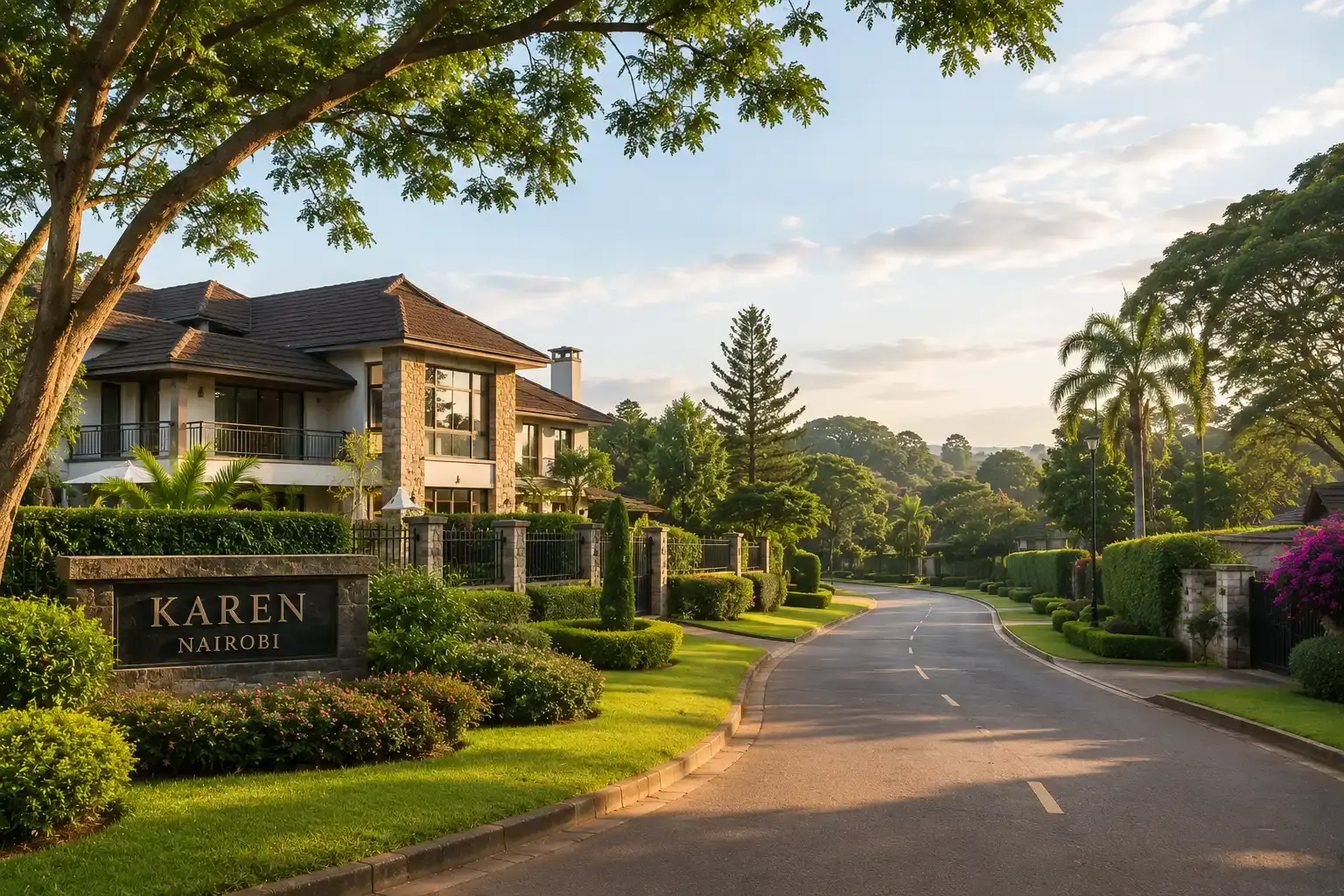
There's a specific moment Karen residents often describe: you turn off Ngong or Langata Road, the traffic noise fades, and the city seems to disappear behind hedgerows and mature trees. Karen isn't just another Nairobi suburb — it's arguably the only prestigious neighbourhood in the city that has genuinely opted out of urban density altogether, while still offering the schools, infrastructure, and amenities needed for serious, long-term family life.
That space comes at a cost — Karen is consistently Nairobi's most expensive residential suburb. Here's what it actually costs to live there in 2026, and an honest look at what you're trading for that price.
Where Karen Sits and What Defines It
Karen lies roughly 14–18km southwest of the CBD, connected via Ngong Road, Langata Road, and the Southern Bypass. On paper, that's not far — in practice, the distance is the entire point. Karen was originally settled by European farmers in the early twentieth century (the neighbourhood takes its name from writer Karen Blixen, who farmed here in the 1910s and 20s), and that agricultural history is still visible today in the area's defining feature: large plots, typically half an acre to several acres, with mature indigenous trees and a road layout built for unhurried movement rather than urban throughput.
Karen Property Prices in 2026
Buying: According to current listings data, the average asking price for a house in Karen sits somewhere in the region of KSh 95–134 million, though the range is wide — from around KSh 35 million for an older bungalow on a smaller plot, up to KSh 250 million or more for expansive, ambassadorial-grade homes on multi-acre compounds. Homes with swimming pools average notably higher, and typical listed properties run around 1,400–1,500 square metres in size.
Renting: A 3-bedroom house or maisonette in Karen typically rents for roughly KSh 150,000–200,000/month unfurnished, or KSh 180,000–280,000/month furnished. Smaller apartments (1–2 bedroom) can be found from around KSh 50,000–100,000/month, while larger 4- and 5-bedroom standalone villas commonly range from KSh 250,000 well into the KSh 400,000–650,000+ range for premium gated properties.
Land: Karen land has consistently appreciated at an estimated 10–15% annually, driven by strong, sustained demand and limited available supply within the area's established boundaries.
What Makes Karen Different From Nairobi's Other Prestigious Suburbs
Nairobi essentially has two categories of prestigious neighbourhood. The first is dense and vertical — Kilimani and Westlands fall here, offering proximity and energy in exchange for smaller plots and closer neighbours. Karen is the clearest example of the second category: a suburb that trades density and convenience for space, privacy, and quiet, while still maintaining the schools and infrastructure needed to support families long-term.
Lifestyle and Amenities
Karen residents have access to a genuinely strong set of amenities without needing to travel into central Nairobi:
- The Hub Karen and Galleria Mall for shopping and dining
- Karen Country Club for golf and social life
- Giraffe Centre and Oloolua Nature Trail for outdoor recreation, giving Karen a rare connection to nature within Nairobi's boundaries
- Strong school options, including Hillcrest International School, Brookhouse School, and Nairobi Academy — a major draw for families prioritizing education without relocating outside Nairobi entirely
The Honest Tradeoffs
Commute time. While the distance to the CBD is only 14–18km, actual travel time can be significant, particularly during peak hours. Karen genuinely doesn't suit anyone working in Eastlands, Thika Road, or Mombasa Road, where the added travel time compounds daily.
Higher running costs. Beyond mortgage or rent, Karen properties carry real ongoing costs: security (roughly KSh 10,000–30,000/month for guards or alarm systems), garden maintenance (KSh 5,000–15,000/month), and water. For a typical 4-bedroom home on half an acre, total running costs — excluding mortgage — commonly run KSh 40,000–80,000/month.
Water supply. Karen's municipal water supply is often unreliable, and many properties rely on borehole water as a result — worth factoring into both your budget and due diligence before purchasing.
Land tenure. Most Karen properties are held on freehold title. Non-Kenyan buyers should be aware that foreign ownership of freehold land typically requires conversion to leasehold or purchase through a Kenyan-registered company — a structuring detail worth discussing with a property lawyer early in the process.
Boundary considerations. Given Karen's large plot sizes, boundary disputes are a more relevant risk than in denser apartment-focused neighbourhoods. Commissioning an independent survey before completing any purchase is strongly advisable.
What's Coming: Infrastructure Improvements
Planned dualling of Ngong Road is expected to meaningfully improve Karen's accessibility over the coming years, which many market observers point to as a factor likely to further support the area's already strong land appreciation.
Who Should Choose Karen?
- Families prioritizing space, greenery, and strong school access over a short commute
- Buyers and renters with the budget to absorb both premium pricing and higher ongoing running costs
- Diplomats, executives, and expats seeking privacy and a distinctly different pace from Nairobi's denser central suburbs
- Long-term investors comfortable with land as a slower-moving, appreciation-focused asset rather than a high-yield rental play
Who Should Look Elsewhere?
- Budgets under roughly KSh 100,000/month for rent, where a standalone Karen house won't be realistic
- Anyone commuting regularly to Eastlands, Thika Road, or Mombasa Road, where Karen's location adds significant daily travel time
- Buyers or renters prioritizing walkable urban density over space and privacy — Kilimani or Westlands would likely be a better fit
Explore Karen Listings with Masion
Karen asks something real of the people who choose it — a longer commute, higher running costs, and a premium price tag. In return, it offers a quality of residential life that's genuinely difficult to find anywhere else in Nairobi. At Masion, we list verified properties across Karen to help you weigh that tradeoff with confidence.
Browse verified Karen listings today at masion.co.ke.
A little more clarity
Frequently asked questions
What does this article cover?
There's a specific moment Karen residents often describe: you turn off Ngong or Langata Road, the traffic noise fades, and the city seems to disappear behind hedgerows and mature trees. Karen isn't just another Nairobi suburb — it's arguably the only prestigious neighbourhood in the city that has genuinely opted out of urban density altogether, while still offering the schools, infrastructure, and
How can I find properties related to my requirements?
Browse the property listings and filter by location, price, and property type. You can also use Request a Property to share your requirements and receive matching suggestions.
How can I ask about a property?
Open the property page to review its details and contact the listing agent using the enquiry options shown there. Confirm availability and arrange a viewing with the agent.
Join the conversation
Comments
Looking for a property?Get help with a request tailored to your location and budget.
No comments yet. Share a thought or ask a question above.