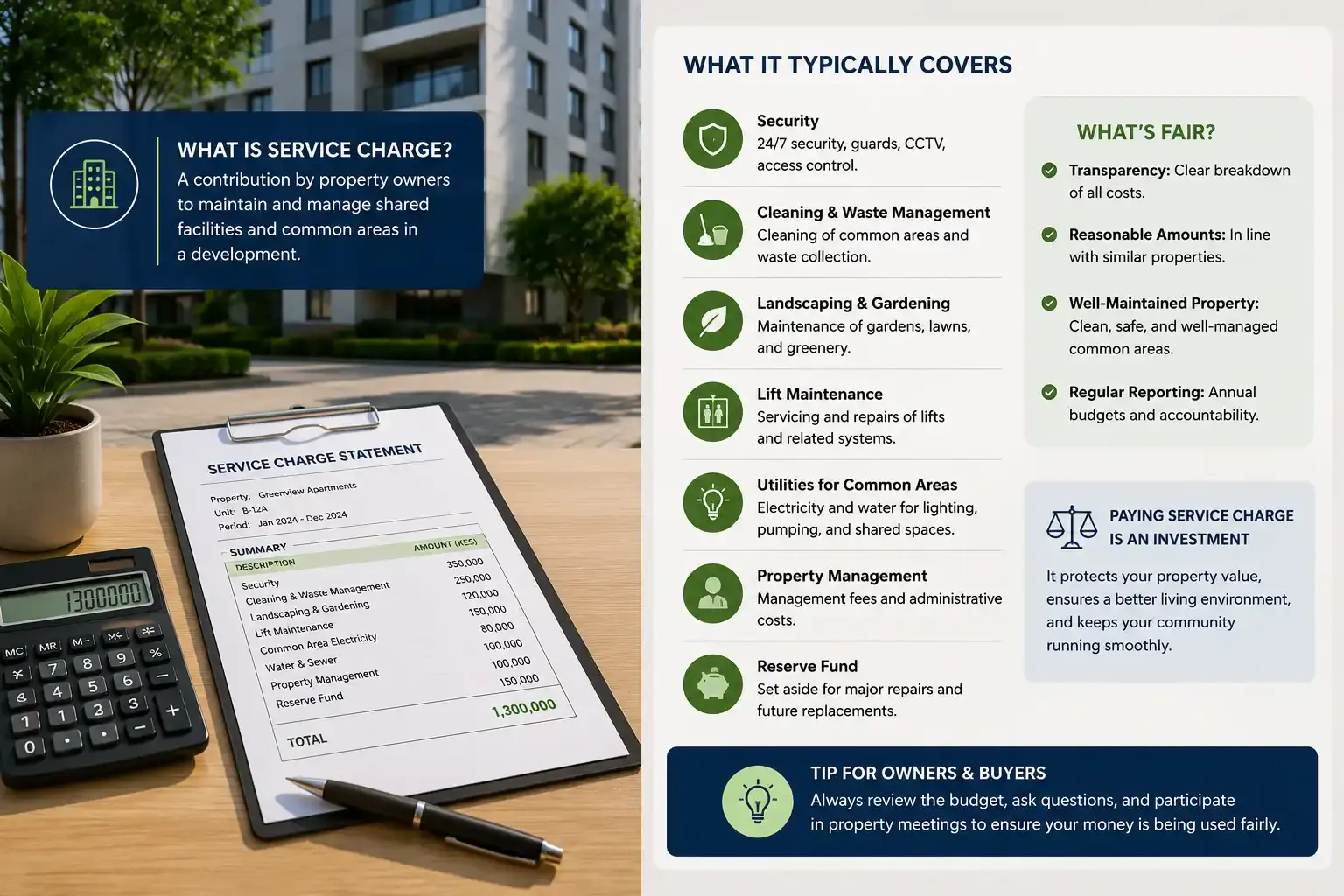
Service charge is one of the most misunderstood costs in Kenyan apartment living — often mentioned briefly during a viewing, then quietly becoming one of the larger recurring costs a tenant or owner pays each month. Understanding exactly what it should cover, and what a fair rate looks like, protects you from both nasty surprises and overpaying for services you're not actually receiving.
What Service Charge Actually Is
Service charge is a recurring fee — typically monthly or quarterly — paid by tenants or unit owners in a multi-unit building or gated development, covering the cost of maintaining and managing shared spaces and services that benefit the entire property, rather than any single unit.
What Service Charge Should Typically Cover
- Security — guards, gate operations, CCTV maintenance, and access control systems
- Common area cleaning and maintenance — hallways, lobbies, stairwells, parking areas, gardens, and compound upkeep
- Waste collection — garbage removal from the property
- Common utility costs — electricity for shared lighting, water pumps, lifts, and other communal systems
- Building maintenance and minor repairs — upkeep of shared infrastructure like lifts, generators, water tanks, and perimeter walls
- Management fees — payment to whoever administers the building or estate (a property management company or resident association)
- Reserve/sinking fund contributions — a portion set aside for larger, less frequent expenses like repainting, major equipment replacement, or significant repairs
What Service Charge Should NOT Cover
- Your individual unit's utilities — your own electricity and water consumption should be separately metered and billed, not bundled into service charge
- Your unit's internal maintenance — repairs or upkeep inside your specific unit are generally your own responsibility, not the building's
- Costs unrelated to the property — service charge should be traceable to actual shared expenses, not a general revenue stream for the landlord or developer
If you notice service charge increasing without any corresponding explanation of what's driving the increase, it's reasonable to request an itemized breakdown.
Typical Service Charge Rates in Kenya
Service charge varies significantly based on the building's amenities, security level, and location, but as a general guide:
- Basic apartment buildings with standard security and cleaning: relatively modest monthly rates
- Mid-range developments with more amenities (better security, gym, larger compound): moderate rates
- Premium developments with extensive amenities (pool, gym, generator backup, extensive landscaping, concierge services): significantly higher rates, reflecting the broader range of services provided
As a rough guide, service charge commonly represents somewhere in the range of 10–20% of the base rent, though this varies considerably by building and should always be confirmed directly rather than assumed.
How to Know If Your Service Charge Is Fair
1. Ask for an itemized breakdown. A legitimate management company or landlord should be able to explain specifically what the service charge funds — security costs, cleaning contracts, utility costs for common areas, and so on.
2. Compare against similar buildings in the area. Service charge rates for comparable buildings (similar amenities, similar location) give you a useful benchmark for whether a specific charge seems reasonable.
3. Assess whether the amenities match the cost. A high service charge is more justifiable in a building with a pool, gym, backup generator, and extensive landscaping than in a basic building with minimal shared amenities.
4. Check whether the charge has increased without explanation. Reasonable annual adjustments (reflecting rising costs like security contracts or utility prices) are normal, but a significant, unexplained jump is worth questioning directly.
5. Observe whether the services are actually being delivered. If security, cleaning, or maintenance visibly aren't happening consistently despite paying service charge, that's a legitimate basis for raising concerns with management.
Who Sets and Manages Service Charge?
Service charge is typically set and managed by:
- The developer or landlord directly, in smaller buildings without a formal residents' association
- A property management company, hired to handle day-to-day operations and often responsible for setting and collecting service charge on behalf of owners
- A residents' or owners' association, more common in larger estates or condominium-style developments, where unit owners collectively have some say in how service charge is set and spent
Understanding which of these applies to your specific building affects who you'd approach with questions or concerns.
What to Do If You Believe Service Charge Is Unfair
- Request a detailed, itemized breakdown of what the charge covers, in writing
- Compare with similar buildings to establish whether the rate is genuinely out of line with the market
- Raise concerns directly and professionally with the landlord, management company, or residents' association
- Review your lease or ownership documents for any clauses specifically addressing service charge adjustments or dispute processes
- Consider involving a lawyer if the dispute is significant and can't be resolved through direct discussion, particularly for unit owners facing ongoing disputes with a management body
Service Charge Considerations for Buyers vs Renters
For renters: Confirm clearly during the viewing and lease negotiation whether service charge is included in the quoted rent or billed separately, and get the exact amount in writing before signing.
For buyers: Service charge is an ongoing cost that affects the true cost of ownership beyond your mortgage payment — factor it into your budget calculations, and ask for the building's service charge history (including any past disputes or significant increases) as part of your due diligence before purchasing.
Find Transparent Listings with Masion
At Masion, we list verified rental and sale properties with clear information on service charge and other associated costs, helping you budget accurately and avoid unwelcome surprises after you've committed to a property.
Browse listings with transparent pricing at masion.co.ke.
FAQs
1. Is service charge the same as rent? No, they're separate. Rent pays for the use of your specific unit, while service charge covers the maintenance and management of shared spaces and services across the entire building or development.
2. Can a landlord increase service charge whenever they want? Generally, reasonable adjustments reflecting genuine rising costs are normal, but significant or unexplained increases should be questioned. Reviewing your lease for any specific clauses on this is worthwhile before signing.
3. What's a typical service charge percentage relative to rent in Kenya? It varies by building, but service charge commonly falls somewhere around 10–20% of base rent, with premium buildings offering more amenities typically at the higher end of that range.
4. Should my own electricity and water bills be included in service charge? No — your individual unit's utility consumption should be separately metered and billed to you directly, not bundled into the shared service charge.
5. What should I do if I think my building's service charge is too high? Request an itemized breakdown, compare it against similar buildings in the area, and raise concerns directly with the landlord, management company, or residents' association if the rate still seems unreasonable.
6. Do property buyers need to worry about service charge, or just renters? Buyers should absolutely factor it in — service charge is an ongoing cost of ownership beyond the mortgage, and reviewing the building's service charge history is a worthwhile part of due diligence before purchasing.
A little more clarity
Frequently asked questions
What does this article cover?
Service charge is one of the most misunderstood costs in Kenyan apartment living — often mentioned briefly during a viewing, then quietly becoming one of the larger recurring costs a tenant or owner pays each month. Understanding exactly what it should cover, and what a fair rate looks like, protects you from both nasty surprises and overpaying for services you're not actually receiving.
How can I find properties related to my requirements?
Browse the property listings and filter by location, price, and property type. You can also use Request a Property to share your requirements and receive matching suggestions.
How can I ask about a property?
Open the property page to review its details and contact the listing agent using the enquiry options shown there. Confirm availability and arrange a viewing with the agent.


Join the conversation
Comments
Looking for a property?Get help with a request tailored to your location and budget.
No comments yet. Share a thought or ask a question above.