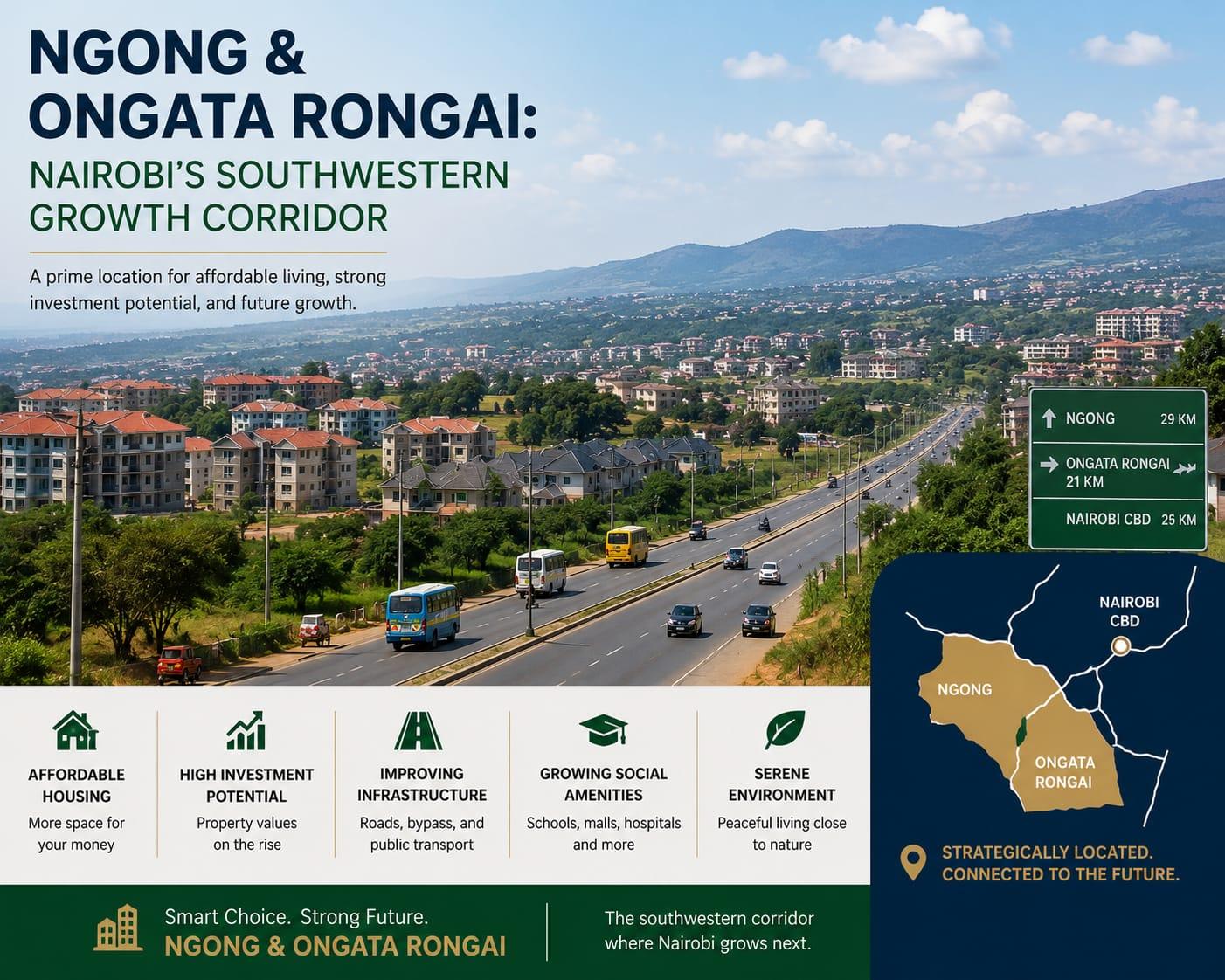
Southwest of Nairobi, along Ngong Road and Magadi Road, two well-established satellite towns — Ngong and Ongata Rongai — have quietly built some of the most consistent rental demand in the entire Nairobi Metropolitan Area, even as sale prices in the broader corridor have softened recently. Both offer genuine affordability relative to Nairobi proper, though each has developed its own distinct character. Here's how they compare in 2026.
Ongata Rongai: The Larger, More Developed Option
Ongata Rongai — often simply called "Rongai" — sits in Kajiado County, connected to Nairobi via Magadi Road, with matatus, buses, Uber, and Bolt all serving the route, plus Southern Bypass access for wider connections across the city. Originally Maasai-occupied plains land (the name itself refers to an area of narrow plains), Rongai has grown into a genuinely diverse town housing everyone from business leaders and expatriates to students and young families.
Prices for sale: The average house price in Ongata Rongai currently sits around KSh 15.6 million, though this has softened by roughly 2.7% in the most recent quarter as household budgets have tightened across the broader market.
Rental prices: Bedsitters and self-contained units start from around KSh 7,500/month, 3-bedroom houses and apartments from roughly KSh 35,000/month, and own-compound houses average around KSh 57,200/month (ranging from KSh 25,000 to KSh 130,000 depending on size and finishes). Larger, premium properties can command considerably more.
Rental demand: This is where Rongai genuinely stands out — rental growth of roughly 2.2% in the most recent quarter was the second-highest of any satellite town tracked, behind only Ruiru, reflecting strong and resilient demand for rental housing even as sale prices softened.
Amenities and schools: Ongata Academy, PCEA Ongata Rongai School, Maasai Technical Training Institute, and Multimedia University of Kenya all serve the area, while residents have easy access to Maasai Lodge, Nairobi National Park, and Galleria Mall for recreation and shopping.
Ngong: Quieter, With a Distinct Character
Ngong sits further along the same southwestern corridor, connected to Nairobi via Ngong Road through Karen and Langata, and known distinctly for the Ngong Hills — a popular hiking and weekend destination that gives the town a slightly different identity from Rongai's more purely residential-commercial character.
Prices for sale: The average house price in Ngong sits around KSh 19.4 million, having declined roughly 2.5% in the most recent quarter, broadly in line with the softening seen across several satellite towns as buyer budgets have tightened.
Character: Ngong tends to feel somewhat quieter and more spread out than Rongai, with its proximity to the Ngong Hills giving it a genuine outdoor recreation identity alongside its residential growth.
Ngong and Ongata Rongai: Side by Side
- Average sale price: Ngong (~KSh 19.4M) runs somewhat higher than Ongata Rongai (~KSh 15.6M)
- Rental demand: Ongata Rongai has shown notably stronger recent rental growth (2.2%) than most comparable satellite towns
- Access to Nairobi: Rongai connects via Magadi Road and the Southern Bypass; Ngong connects via Ngong Road through Karen and Langata
- Character: Rongai is more built-up and commercially developed; Ngong retains a quieter, more outdoor-oriented identity tied to the Ngong Hills
- Best for: Rongai suits renters and buyers prioritizing amenities, schools, and stronger rental market activity; Ngong suits those wanting a quieter setting with easy access to hiking and outdoor recreation, while still being commutable to Karen and central Nairobi
The Broader Market Context: Softening Sales, Resilient Rentals
Both towns reflect a pattern seen across several Nairobi satellite towns recently — a modest decline in sale prices (alongside similar softening in Kiambu, Kitengela, and Kiserian) even as rental demand has remained genuinely strong, driven by Kenya's ongoing housing deficit. Overall satellite town rental yields have actually risen slightly to around 5.4%, up marginally from the prior quarter — a reminder that softer sale prices don't necessarily mean weaker fundamentals for landlords, particularly in areas like Rongai with resilient rental demand.
For context, this satellite town performance compares against Nairobi's established suburbs, where areas like Karen posted the strongest sale price growth in the same period — a dynamic we cover in more detail in our guide on living in Karen.
Why Buyers and Renters Are Drawn to This Corridor
- Genuine affordability relative to central Nairobi and even some other satellite towns
- Strong, diverse rental demand in Rongai specifically, supporting steady occupancy for landlords
- A more relaxed, spacious lifestyle compared to denser central suburbs, with own-compound houses widely available
- Established infrastructure and amenities, including reputable schools and shopping centres, reducing the need to travel into central Nairobi for daily needs
- Recreational access — particularly in Ngong, where the Hills offer a genuine outdoor lifestyle amenity uncommon elsewhere in the Nairobi Metropolitan Area
What to Watch For
Given the recent softening in sale prices across this corridor, buyers should approach purchase decisions with realistic expectations about near-term appreciation, while renters and investors can take some comfort in the resilient rental demand data, particularly in Ongata Rongai. As with any satellite town purchase, verifying water and electricity access for a specific plot or property — since availability can vary meaningfully between developments — remains an essential part of due diligence, alongside standard title verification.
Explore Ngong and Ongata Rongai with Masion
Whether you're drawn to Rongai's stronger rental market or Ngong's quieter, hills-adjacent lifestyle, Masion lists verified properties across both towns to help you compare real, current options.
Browse Ngong and Ongata Rongai listings today at masion.co.ke.
FAQs
1. Which is cheaper: Ngong or Ongata Rongai? Ongata Rongai has the lower average sale price of the two, at roughly KSh 15.6 million compared to Ngong's roughly KSh 19.4 million, though both have seen modest recent price softening.
2. Which has stronger rental demand: Ngong or Ongata Rongai? Ongata Rongai has shown particularly strong recent rental growth, ranking as the second-highest among tracked satellite towns, making it a notably resilient market for landlords even as sale prices have softened.
3. How do I get from Ongata Rongai to Nairobi? Via Magadi Road, with matatus, buses, Uber, and Bolt all available, plus Southern Bypass access for broader connections across the city.
4. Is Ngong a good choice for outdoor recreation? Yes, distinctly so — the Ngong Hills give the town a genuine hiking and outdoor recreation identity that's uncommon among Nairobi's other satellite towns.
5. Why have sale prices softened in this corridor recently? Recent market data attributes this to tightening household budgets more broadly, a pattern also seen in nearby areas like Kiambu, Kitengela, and Kiserian, rather than a specific issue unique to Ngong or Rongai.
6. What rental yields can investors expect in this corridor? Overall satellite town yields have risen slightly to around 5.4%, with Ongata Rongai's particularly strong rental demand suggesting solid occupancy potential for landlords in that specific market.
A little more clarity
Frequently asked questions
What does this article cover?
Southwest of Nairobi, along Ngong Road and Magadi Road, two well-established satellite towns — Ngong and Ongata Rongai — have quietly built some of the most consistent rental demand in the entire Nairobi Metropolitan Area, even as sale prices in the broader corridor have softened recently.
How can I find properties related to my requirements?
Browse the property listings and filter by location, price, and property type. You can also use Request a Property to share your requirements and receive matching suggestions.
How can I ask about a property?
Open the property page to review its details and contact the listing agent using the enquiry options shown there. Confirm availability and arrange a viewing with the agent.
Join the conversation
Comments
Looking for a property?Get help with a request tailored to your location and budget.
No comments yet. Share a thought or ask a question above.