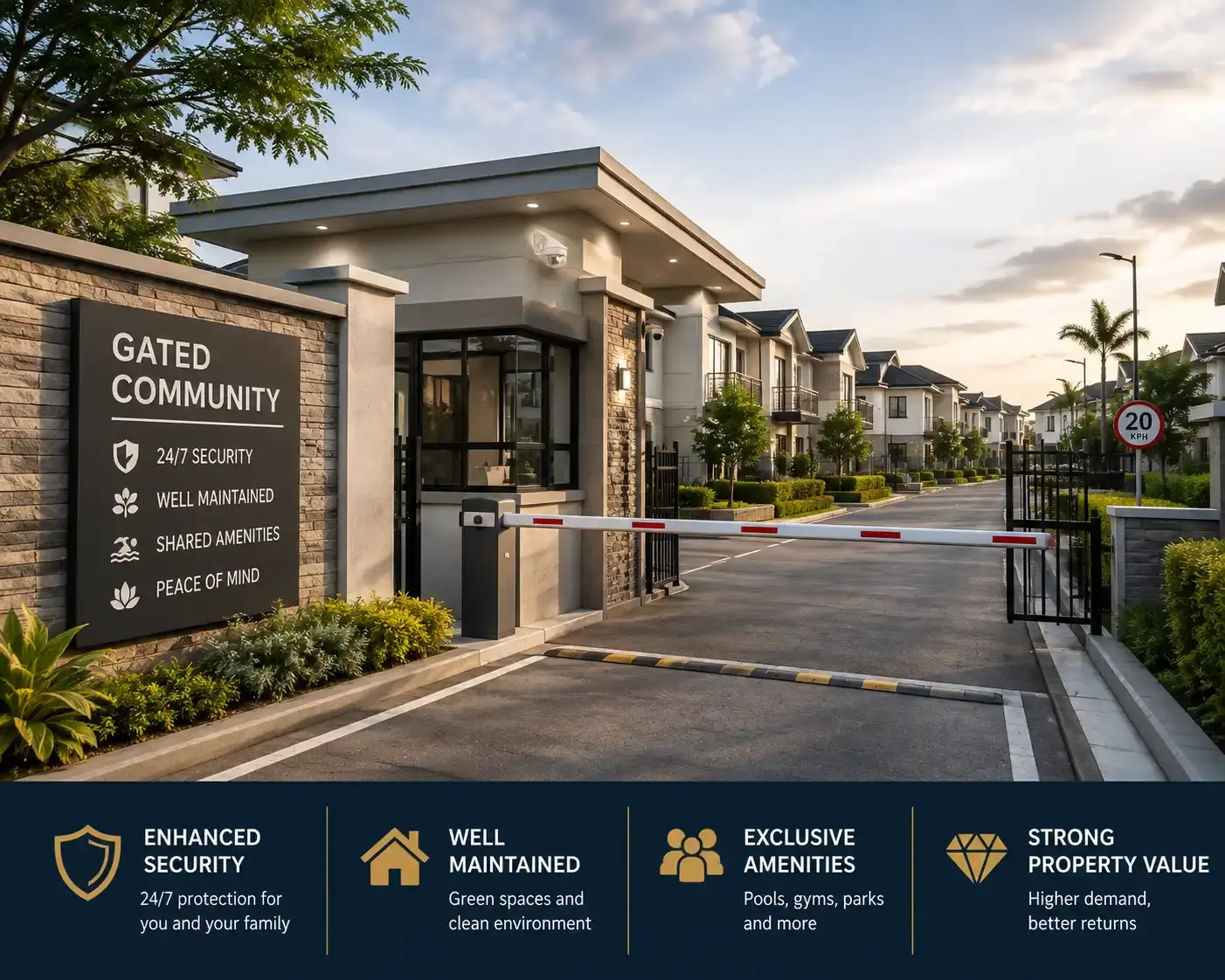
But is that premium actually worth paying, or are buyers and renters simply paying for a label? Here's an honest look at what you actually get.
What Defines a Gated Community
A gated community typically features a perimeter wall or fence, controlled access (a manned gate, sometimes with electronic access control), shared security arrangements, and often shared amenities — a clubhouse, playground, sports facilities, or communal green space — managed collectively rather than individually by each homeowner.
What You're Actually Paying For
1. Shared, Professional Security
This is usually the primary draw. Rather than each household independently arranging and funding security, a gated community spreads this cost across all residents while typically providing a higher standard of coordinated security — perimeter monitoring, controlled entry, sometimes CCTV coverage — than most individual households would arrange on their own.
2. Consistent Property Standards
Many gated communities enforce architectural and maintenance guidelines, helping preserve a consistent, well-kept appearance across the development — protecting against the property value impact of a poorly maintained neighbouring property, which is a real risk in ungated developments.
3. Shared Amenities
Depending on the development, this can include a clubhouse, gym, swimming pool, children's play areas, or sports facilities — amenities that would be prohibitively expensive for an individual household to build and maintain independently, but become affordable when shared across many residents.
4. Community and Social Environment
Gated communities often foster a stronger sense of community among residents, particularly appealing to families with children who benefit from a controlled, socially cohesive environment for kids to play and interact safely.
5. Professional Management
Common areas, security, and shared infrastructure are typically managed by a dedicated management company or residents' association, removing the burden of coordinating these things individually — though this comes with its own service charge cost, discussed below.
The Real Costs Beyond the Purchase Price
Higher Purchase or Rental Price
Gated community properties command a genuine premium over comparable standalone properties outside gated developments — reflecting the security, amenities, and management infrastructure included.
Ongoing Service Charge
Beyond the purchase or rental price, gated communities typically carry meaningful service charge costs — covering security, common area maintenance, amenities upkeep, and management fees — an ongoing cost that ungated standalone properties simply don't carry in the same structured way.
Less Individual Control
Architectural guidelines and community rules, while protecting overall property standards, also mean less individual freedom to modify or use your property exactly as you might wish, compared to a fully independent standalone home.
Dependency on Management Quality
The value of gated community living depends heavily on how well the development is actually managed — a poorly managed gated community can deliver a worse experience (inconsistent security, deferred maintenance, mismanaged funds) than a well-run ungated alternative, despite the premium paid.
When the Premium Is Genuinely Worth It
- Families with young children who benefit significantly from a secure, controlled environment for outdoor play
- Buyers in areas with genuine security concerns, where the shared security infrastructure represents a real, meaningful improvement over what an individual household could arrange
- Those who value amenities they'd actually use — a pool, gym, or clubhouse that genuinely fits their lifestyle, rather than sitting unused
- Buyers prioritizing consistent property standards and protection against the value impact of poorly maintained neighbouring properties
- Those who prefer not to manage security and common area maintenance independently, valuing the convenience of professional management despite its cost
When It Might Not Be Worth It
- Buyers on a tight budget for whom the premium meaningfully limits options elsewhere, without a correspondingly strong personal need for the specific benefits gated living provides
- Those who value maximum individual property control and are less concerned about architectural consistency or community rules
- Buyers in genuinely low-risk areas where standalone security arrangements would adequately meet their needs without the added structural cost
- Renters or buyers who wouldn't actually use the amenities, effectively paying for features that don't add real personal value
How to Evaluate a Specific Gated Community
Rather than assuming all gated communities deliver equal value, evaluate each specific development on its own merits:
- Ask about the current service charge and what it actually covers — verify this matches what's promised, not just what's advertised
- Ask about the sinking fund (see our guide on what a sinking fund is and why it matters) to gauge whether the development is being managed with an eye toward long-term maintenance
- Talk to current residents where possible, about their genuine experience with security, management responsiveness, and amenity upkeep
- Visit at different times of day to observe actual security practices and general upkeep, rather than relying solely on marketing materials or a single scheduled viewing
- Review the management structure — is it a professional management company, or a less formal resident-run arrangement, and does either inspire genuine confidence?
The Honest Bottom Line
Gated community living genuinely delivers real value for many buyers and renters — particularly families prioritizing security and amenities they'll actually use. But the premium isn't automatically worth paying for everyone, and the quality of that value depends heavily on how well a specific development is actually managed, not just whether it carries the "gated community" label. Evaluating the specific development, rather than the category broadly, is the more useful exercise.
Explore Gated and Standalone Properties with Masion
Whether a gated community fits your priorities or you'd rather invest that premium elsewhere, Masion lists verified properties across both gated developments and standalone options throughout Kenya, helping you compare real choices side by side.
Browse gated community and standalone listings at masion.co.ke.
FAQs
1. How much more expensive is a gated community compared to a standalone property? This varies significantly by location and specific development, but gated communities generally command a genuine premium over comparable standalone properties, reflecting the security, amenities, and management infrastructure included.
2. Is the service charge in a gated community worth the cost? It depends on what's actually delivered — a well-managed gated community with genuine security and amenities can represent good value, while a poorly managed one may not justify its ongoing service charge relative to a standalone alternative.
3. Do all gated communities offer the same amenities? No, amenities vary considerably by development — some offer extensive facilities like pools and clubhouses, while others provide primarily security and basic common area maintenance, making it important to evaluate what a specific development actually includes.
4. Are gated communities better for families with children? Generally, yes — the controlled, secure environment is particularly valued by families with young children who benefit from a safer space for outdoor play compared to many standalone or ungated settings.
5. Can I modify my property freely in a gated community? Often with more restrictions than a standalone property — many gated communities enforce architectural and maintenance guidelines to preserve consistent property standards, which limits some individual modification freedom.
6. How can I tell if a gated community is well-managed before buying or renting? Ask about the current service charge and sinking fund, talk to current residents about their genuine experience, visit at different times of day, and review who manages the development — a professional management company generally, though not always, indicates more structured oversight.
A little more clarity
Frequently asked questions
What does this article cover?
Gated communities have become one of the defining features of Kenya's growing satellite towns and premium suburbs alike — offering shared security, amenities, and a managed environment in exchange for a genuine price premium over comparable standalone properties.
How can I find properties related to my requirements?
Browse the property listings and filter by location, price, and property type. You can also use Request a Property to share your requirements and receive matching suggestions.
How can I ask about a property?
Open the property page to review its details and contact the listing agent using the enquiry options shown there. Confirm availability and arrange a viewing with the agent.


Join the conversation
Comments
Looking for a property?Get help with a request tailored to your location and budget.
No comments yet. Share a thought or ask a question above.