As Nairobi's central suburbs have grown increasingly expensive, the corridor along Mombasa Road — anchored by Syokimau and Athi River — has emerged as one of the city's most practical answers to the affordability question. Both towns sit roughly 25–30km southeast of the CBD, both benefit from the Nairobi Commuter Rail (SGR-linked DMU service), and both offer genuinely lower entry prices than almost anywhere inside Nairobi proper. But they're not interchangeable — each has a distinct character worth understanding before you buy or rent.
Syokimau: Convenient, But Increasingly Priced For It
Syokimau is the closer and more polished of the two, sitting closest to both the CBD and Jomo Kenyatta International Airport (JKIA) — roughly 7 minutes from the airport and about 25 minutes into the CBD via the commuter train.
Prices: 2-bedroom apartments start from around KSh 4.4 million, with the broader apartment range running roughly KSh 5–8 million. Rent starts from around KSh 25,000/month for smaller units.
Rental yields: Estimated at 6–8% gross, comparable to the broader satellite town average.
What drives demand: The commuter rail connection is Syokimau's defining advantage — DMU trains run around six times daily on the Syokimau–Nairobi Central route, with early departures from as early as 6:55 AM, making a genuine daily commute practical rather than aspirational. Proximity to JKIA also creates steady, specific demand from airport and airline staff, plus travelers needing convenient short-term accommodation. Property prices have risen at a modest but consistent pace, around 4% annually in recent data, and Syokimau consistently ranks among the most-searched satellite towns on Kenyan property portals.
The catch: Convenience comes at a cost — plot sizes tend to be smaller than in Athi River or Kitengela, and Syokimau now commands a genuine premium within the corridor rather than being the budget option it once was.
Athi River (Mavoko): Bigger Discount, Bigger Tradeoffs
Athi River — officially Mavoko — sits a bit further out, straddling Machakos County and the edge of the Nairobi Metropolitan Area. It's one of Kenya's fastest-growing satellite towns, with a population that has swelled past 360,000.
Prices: Considerably more affordable than Syokimau — houses sell from around KSh 2.75 million for serviced plots up to roughly KSh 25 million for 4-bedroom maisonettes in gated estates. Rentals start from around KSh 10,000/month for a bedsitter. At current exchange rates, a 3-bedroom apartment around KSh 6.5 million works out to roughly $50,000 — notably below entry prices in Kilimani or even Syokimau itself.
Rental yields: Similar to Syokimau at 5–7%, though with more competition from new supply entering the market.
Commute: The Athi River SGR station connects to Nairobi Terminus in roughly 20 minutes — faster and more predictable than driving. Matatus run frequently along Mombasa Road too, though rush-hour road journeys can stretch to 90–120 minutes, underscoring the rail line's real value here.
The honest tradeoffs: Athi River's affordability comes with genuine industrial-town realities — more than 400 factories operate in the area, bringing cement dust and unplanned mixing of industry with residential development in parts of town. Water is the most commonly cited infrastructure challenge — the town depends partly on Nairobi's water supply, supplemented by boreholes and the Portland Dam, and rationing is common enough that many estates budget an additional KSh 2,000–5,000/month for supplementary borehole water.
What's improved: Shopping and amenities have genuinely caught up in recent years — Crystal Rivers Mall and Signature Mall now provide supermarkets, banks, and restaurants that simply weren't available a decade ago.
Syokimau vs Athi River: Quick Comparison
- Price: Athi River is meaningfully cheaper across almost every property type
- Commute: Both benefit from commuter rail; Syokimau is marginally closer to the CBD and notably closer to JKIA
- Infrastructure challenges: Athi River faces more pronounced water and industrial-proximity issues; Syokimau is generally cleaner and more residential in character
- Plot sizes: Athi River generally offers larger plots for the price; Syokimau's are more compact given its premium positioning
- Rental yields: Comparable between the two, in the 5–8% range
- Best for: Syokimau suits buyers prioritizing JKIA proximity and a slightly more polished, established feel; Athi River suits buyers prioritizing maximum affordability and larger plot sizes, provided they can accept its industrial-town character
Infrastructure Investment on the Horizon
A significant piece of news for this corridor: the World Bank committed USD 500 million in March 2026 toward upgrading the 57-kilometre Nairobi Central–Thika commuter rail line, part of a broader USD 1.7 billion project. Investment of this scale in the region's commuter rail infrastructure is a meaningful signal for the corridor's longer-term accessibility and, by extension, its property value trajectory.
Schools and Amenities
Syokimau has a growing selection of schools, including Syokimau Blessed School and Zuwena International School, with Daystar University nearby in Athi River for higher education. Notably, the SGR line running through this corridor actually passes through Nairobi National Park, giving residents the unusual experience of spotting wildlife from the train window during their daily commute.
Who Should Choose This Corridor?
- Budget-conscious buyers and renters who want genuine value without leaving the Nairobi Metropolitan Area entirely
- JKIA-adjacent workers — airline staff, airport employees, frequent travelers — for whom Syokimau's proximity is a specific, practical advantage
- Buyers prioritizing rail commute reliability over the flexibility (and traffic risk) of driving into central Nairobi
- Investors seeking solid, if not spectacular, rental yields in the 5–8% range, with Syokimau's rail and airport proximity offering somewhat more demand stability than Athi River's more supply-competitive market
For a look at how this corridor's investment profile compares to more centrally located suburbs, see our guide on REITs vs direct property ownership in Kenya for a broader framework on evaluating real estate returns.
Explore Syokimau and Athi River with Masion
Whether Syokimau's convenience or Athi River's affordability better fits your budget and priorities, Masion lists verified properties across Nairobi's commuter belt to help you compare real, current options.
Browse Syokimau and Athi River listings today at masion.co.ke.
FAQs
1. Which is cheaper: Syokimau or Athi River? Athi River is meaningfully cheaper across most property types — houses start from around KSh 2.75 million for serviced plots, compared to Syokimau's 2-bedroom apartments starting from roughly KSh 4.4 million.
2. How long does the commute to Nairobi CBD take from these areas? Via the commuter train, Syokimau to Nairobi Central takes roughly 25 minutes, while Athi River to Nairobi Terminus takes roughly 20 minutes — both considerably faster and more predictable than driving during peak hours.
3. Is water supply really a problem in Athi River? Yes, it's the most commonly cited infrastructure challenge in the area — rationing is common, and many estates budget an additional KSh 2,000–5,000/month for supplementary borehole water on top of the main supply.
4. Why is Syokimau more expensive than Athi River despite being in the same corridor? Syokimau's closer proximity to both the CBD and JKIA, combined with its more established, cleaner residential character, commands a premium over Athi River's more industrial, still-developing profile.
5. What are typical rental yields in Syokimau and Athi River? Syokimau yields run around 6–8% gross, while Athi River is similar at 5–7%, though Athi River faces somewhat more competition from new supply entering the rental market.
6. Is there major infrastructure investment planned for this corridor? Yes — the World Bank committed USD 500 million in March 2026 toward upgrading the Nairobi Central–Thika commuter rail line, a meaningful signal for the corridor's longer-term accessibility and property value trajectory.
Related posts:
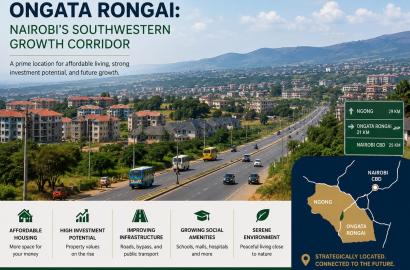
Southwest of Nairobi, along Ngong Road and Magadi Road, two well-established satellite towns — Ngong and Ongata Rongai — have quietly built some of the most consistent rental demand in the entire Nairobi Metropolitan Area, even as sale prices in...
Thirty years ago, Kitengela was Maasai group ranch land on the far southern edge of Nairobi's reach. Today it's a bustling suburban town with malls, international schools, and one of the strongest value propositions in the entire Nairobi Metropolitan Area...
 Ngong and Ongata Rongai: Nairobi's Southwestern Growth Corridor
  Gated Community Living: Is the Premium Worth It?
  Buying Property Through a SACCO: How It Works
  How to Handle a Dispute With Your Landlord or Tenant
  Kitengela: Why It's Attracting First-Time Buyers
Comments
0 approved commentsNo approved comments yet. Be the first to comment.