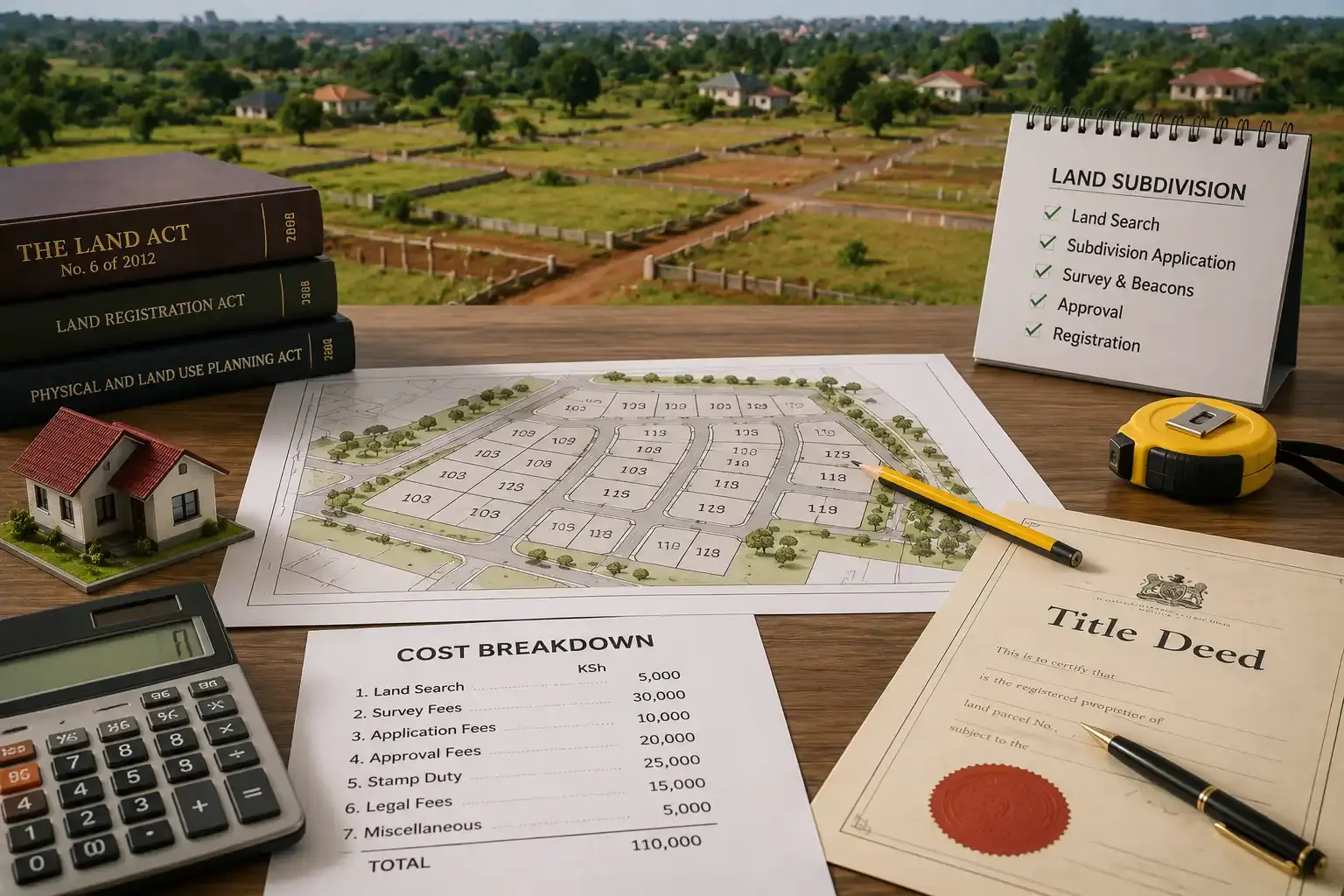
Subdividing land — splitting one large parcel into smaller plots — is one of the most common strategies Kenyan landowners use to unlock value, whether for sale, inheritance, or development. Smaller plots are more affordable to more buyers, which often means a higher combined value than the original single parcel. But subdivision is a legally regulated process, not a paperwork formality, and getting it wrong can leave you with an illegal, unregistrable, or disputed subdivision.
Here's what the law actually requires, what it costs, and where landowners commonly go wrong.
The Legal Framework Governing Subdivision
Land subdivision in Kenya is governed by several overlapping laws:
- The Land Registration Act (2012) — governs registration and titling of the new subdivided parcels
- The Physical and Land Use Planning Act (2019) — requires county government approval before any subdivision proceeds
- The Land Control Act (Cap 302) — specifically controls transactions, including subdivision, of agricultural land, requiring Land Control Board (LCB) consent
- The Environmental Management and Coordination Act (EMCA) — may require an environmental impact assessment for larger subdivisions
- County Government Acts and local zoning bylaws — each county sets its own specific planning and zoning requirements, meaning the exact process can vary depending on where the land is located
Ignoring any of these can result in a subdivision being declared illegal, fines, or — in the case of missing Land Control Board consent for agricultural land — the subdivision being legally void from the outset.
Minimum Acreage Rules
Kenya doesn't yet have a single, nationally standardized minimum and maximum landholding law — a proposed bill (the Kenya Minimum and Maximum Land Holding Acreage Bill, 2015) has stalled without being passed. In practice, minimum subdivision sizes are generally guided by:
- Around 1 acre in high-potential agricultural areas (such as parts of Nandi or Uasin Gishu counties), to keep parcels economically viable for farming
- Around 0.4 hectares (roughly 1 acre) as a general guide in other rural agricultural areas
- Subdivision of agricultural or forest land below 8 hectares generally requiring specific approval, reflecting a stronger regulatory interest in preventing over-fragmentation of larger agricultural holdings
- County-specific zoning rules for residential, commercial, and other land uses, which vary significantly from one county to the next
Because these rules vary by county and land classification, always confirm the specific minimum applicable to your parcel with the relevant County Physical Planning Office before planning a subdivision layout.
The Subdivision Process, Step by Step
1. Feasibility check. Confirm your land's zoning classification (agricultural, residential, commercial) and whether utilities — water, electricity, road access — can reasonably reach each proposed new plot. If your land is agricultural and you intend to subdivide for residential use, you'll also need official change-of-use approval, which takes additional time and cost.
2. Engage a licensed surveyor. The surveyor prepares a mutation form — the official document illustrating how the parcel will be divided into new portions. This is a technical, legally required step; survey work alone doesn't confer ownership, but it's the foundation the rest of the process builds on.
3. Prepare and submit your subdivision scheme. This detailed plan — covering plot sizes, internal roads, and any public spaces — is submitted (typically in multiple copies) to your County Government's Department of Physical Planning for review.
4. Obtain Land Control Board consent (for agricultural land). This step is mandatory for agricultural land and legally non-negotiable — subdivision of agricultural land without LCB consent is void under Kenyan law, regardless of what other documentation exists. A meeting with the LCB is a modest, low-cost step relative to the risk of skipping it.
5. County and national review. The county government forwards the proposal to the National Land Commission, which in turn seeks input from the Director of Physical Planning and Director of Survey before recommendations are issued.
6. Surrender land for roads and public space. For larger subdivisions, developers are typically required to surrender a portion of the land — commonly around 20% total, split roughly between roads and open/public space — as part of the approved layout.
7. Registration of new parcels. Once all approvals are secured, each newly subdivided portion is registered at the land registry and issued its own individual title deed, allowing each plot to be sold, transferred, or developed independently of the others.
Realistic Costs to Budget For
Subdivision costs vary considerably based on parcel size, location, and complexity, but budgeting should account for:
- Surveyor fees — for preparing the mutation form and marking new boundaries
- County application and processing fees — varies by county and subdivision size
- Land Control Board fees — a modest, fixed cost for agricultural land consent
- Change-of-use fees — if converting agricultural land to residential or commercial use
- Infrastructure costs — roads, drainage, and utility extensions, particularly significant for larger subdivisions where the county requires infrastructure to be built as part of approval
- Legal fees — for a conveyancing advocate to guide the process and handle registration
- Registration fees — for issuing individual title deeds to each new parcel
Larger subdivisions requiring road construction or utility extension can see infrastructure costs become the single largest line item — this is worth scoping carefully before committing to a subdivision layout.
Common Pitfalls to Avoid
1. Skipping Land Control Board consent. For agricultural land, this is the single most common — and most serious — mistake. A subdivision without LCB consent is legally void, no matter how complete the rest of the paperwork appears.
2. Ignoring minimum acreage requirements. Subdividing agricultural land into plots below the applicable minimum size, without proper approval, is a hallmark of illegal subdivision and a major fraud red flag for buyers to watch for as well.
3. Assuming agricultural land can automatically be used for residential plots. Change of use requires separate, formal approval — it isn't automatic just because a subdivision has been surveyed and registered.
4. Underestimating infrastructure obligations. Failing to budget for required road and open-space surrender, or utility extension, can derail a subdivision financially partway through.
5. Skipping proper legal guidance. Given the number of overlapping laws and county-specific rules involved, attempting a subdivision without an experienced advocate or licensed surveyor significantly increases the risk of costly errors or an unregistrable outcome.
6. Buying into an already "subdivided" plot without verifying legality. If you're purchasing a subdivided plot rather than subdividing yourself, always confirm the subdivision was properly approved — including LCB consent, where applicable — before buying. For more on spotting problematic land purchases generally, see our guide on how to spot a fraudulent land sale in Kenya.
Why Subdivision Can Be a Smart Investment Strategy
Done properly, subdivision can meaningfully increase a parcel's total value — smaller plots are accessible to a wider pool of buyers, and phased selling (releasing plots in batches as infrastructure like roads are completed) can capture rising land values over time rather than selling everything at once. But this upside is entirely dependent on doing the legal process correctly from the start.
Buy or Invest in Properly Subdivided Land with Masion
Whether you're looking to buy a subdivided plot or explore land with subdivision potential, verifying that a parcel's subdivision history is legitimate is essential. At Masion, we list verified land parcels across Kenya, helping you invest with confidence.
Browse verified land listings today at masion.co.ke.
This article is for general informational purposes and does not constitute legal advice. Always consult a licensed advocate and surveyor for guidance specific to your land and county.
FAQs
1. Can I subdivide agricultural land without Land Control Board consent? No. Subdivision of agricultural land without Land Control Board consent is legally void under the Land Control Act, regardless of any other documentation completed.
2. Is there a minimum plot size I can subdivide land into in Kenya? Yes, though it varies by county and land classification — high-potential agricultural areas often require parcels of around 1 acre or more, while other rural areas commonly apply a similar minimum. Always confirm the specific requirement with your County Physical Planning Office.
3. Do I need to build roads if I subdivide my land? For larger subdivisions, yes — developers are typically required to surrender a portion of the land (often around 20% total) for roads and public open space as part of the approved layout.
4. How long does the land subdivision process take in Kenya? It varies significantly based on county processing times, land size, and whether agricultural Land Control Board consent or change-of-use approval is required, but the process commonly takes several months from application to final registration.
5. Can agricultural land automatically be subdivided for residential plots? No. Converting agricultural land to residential use requires a separate, formal change-of-use approval process, in addition to the standard subdivision requirements.
6. How do I know if a subdivided plot I'm buying was legally subdivided? Confirm with the Land Control Board (for agricultural land) and the relevant county planning office that the subdivision was properly approved, and verify the title deed independently through an official land search before purchasing.
A little more clarity
Frequently asked questions
What does this article cover?
Subdividing land — splitting one large parcel into smaller plots — is one of the most common strategies Kenyan landowners use to unlock value, whether for sale, inheritance, or development. Smaller plots are more affordable to more buyers, which often means a higher combined value than the original single parcel. But subdivision is a legally regulated process, not a paperwork formality
How can I find properties related to my requirements?
Browse the property listings and filter by location, price, and property type. You can also use Request a Property to share your requirements and receive matching suggestions.
How can I ask about a property?
Open the property page to review its details and contact the listing agent using the enquiry options shown there. Confirm availability and arrange a viewing with the agent.


Join the conversation
Comments
Looking for a property?Get help with a request tailored to your location and budget.
No comments yet. Share a thought or ask a question above.