Airbnb looked like easy money in Nairobi a few years ago — furnish a unit, list it, and watch nightly rates roll in well above what a long-term tenant would pay. That story has gotten more complicated. Supply has grown faster than demand in several neighbourhoods, and the honest answer to "Airbnb or long-term rental?" now depends heavily on location, management quality, and how realistic your occupancy expectations are. Here's what the current data actually shows.
The Current State of Nairobi's Short-Term Rental Market
Nairobi's short-term rental market has grown substantially — active listings sit somewhere between roughly 4,900 and 13,000 depending on the data source and how listings are tracked, with year-over-year growth in the range of 24% or more. That rapid supply growth is the central tension in the market right now: demand has also grown, but competition among hosts has intensified considerably compared to a few years ago.
Occupancy: Nairobi short-term rentals run at roughly 31–46% average occupancy across the year, depending on the data source and time period measured — meaning a typical Airbnb unit sits empty more nights than it's booked, a critical assumption for anyone running the numbers on potential income.
Average daily rate (ADR): Roughly $42–47 per night (approximately KSh 5,700–6,500), varying significantly by location, property type, and season.
Annual revenue per listing: Estimates vary by data source, ranging from around $3,500 to $7,000 per year (roughly KSh 450,000–900,000) for an average listing — a wide range reflecting how much location and management quality affect actual outcomes.
Where Airbnb Performs Best in Nairobi
Demand remains concentrated in specific, well-located neighbourhoods rather than spread evenly across the city. Westlands, Kilimani, Kileleshwa, and parts of the CBD continue to attract the strongest demand, driven by proximity to offices, malls, and entertainment — appealing to both business travelers and tourists. Properties outside these high-demand corridors face a meaningfully harder path to strong occupancy.
The Case for Airbnb
Higher potential nightly income. Since guests pay per night rather than a fixed monthly rate, a well-located, well-managed unit can generate more total income than an equivalent long-term rental — particularly during peak travel seasons.
Flexibility. Owners can block dates for personal use, or switch a unit between short-term and long-term rental depending on market conditions, cash flow needs, and risk tolerance — a flexibility long-term leases simply don't offer.
Peak season upside. During high-demand periods, nightly rates can climb significantly above average, offering a meaningful income boost concentrated into specific months — though this needs to be weighed against quieter periods where occupancy can drop well below the annual average.
The Case for Long-Term Rental
Predictable, stable income. A signed lease guarantees monthly income regardless of vacancy fluctuations that plague short-term rentals — a meaningful advantage for investors prioritizing steady cash flow over higher, less certain peaks.
Lower ongoing costs. Long-term rentals don't require the furnishing, frequent cleaning, guest communication, and active management that short-term rentals demand — significantly reducing both the time and money invested in ongoing operations.
Lower regulatory uncertainty. Nairobi's short-term rental regulatory environment is currently light — minimal registration requirements and low enforcement — but this is exactly the kind of environment that can shift as local government responds to rapid growth in the sector. Long-term rentals don't carry this same regulatory exposure.
Less operational complexity. No guest turnover, no need for professional management or active pricing strategy — a genuinely more passive investment for owners who don't want to run what is, in effect, a small hospitality business.
The Honest Trade-Off
Short-term rentals essentially require you to run a small hospitality business — furnishing to a guest-ready standard, active pricing strategy, guest communication, cleaning between stays, and either your own time or a professional management fee to handle all of this consistently. Long-term rentals require far less ongoing effort but offer no upside beyond the agreed rent, and less flexibility if your circumstances change.
Industry observers note a fairly common pattern: many investors start with Airbnb to test the market's potential, and switch to long-term rental if actual results don't meet expectations — treating long-term renting as a reliable fallback option rather than the first choice.
A Realistic Way to Decide
Choose Airbnb if:
- Your property is in a genuinely high-demand area (Westlands, Kilimani, Kileleshwa, or similar)
- You're willing to invest in proper furnishing and either active management or a professional management service
- You can financially absorb occupancy running well below 50% in a given month
- You're comfortable treating the property as an active, ongoing hospitality operation, not a passive investment
Choose long-term rental if:
- You want predictable, stable monthly income without seasonal fluctuation
- Your property is outside the specific neighbourhoods where short-term demand is concentrated
- You prefer a lower-effort, more passive investment approach
- You're more risk-averse regarding regulatory changes or demand volatility
Don't Rule Out a Hybrid Approach
Given the flexibility short-term rental platforms allow, some owners run a property as an Airbnb during peak season and switch to a longer-term arrangement (or a mid-term furnished lease) during quieter months — capturing some of Airbnb's peak-season upside while avoiding the worst of its low-occupancy periods. This requires more active management than either pure strategy, but can improve overall annual returns for owners willing to put in the effort.
Explore Both Rental Strategies with Masion
Whether you're weighing Airbnb potential or want the stability of a long-term tenant, Masion lists verified properties across Nairobi's key neighbourhoods to help you evaluate the right strategy for your specific investment goals.
Browse investment properties at masion.co.ke.
FAQs
1. Is Airbnb still profitable in Nairobi in 2026? It can be, but it's far more location- and management-dependent than a few years ago. Well-located properties in areas like Westlands or Kilimani, run with proper management, can outperform long-term rentals — but average occupancy citywide sits around 31–46%, meaning many units underperform expectations.
2. What's the average Airbnb occupancy rate in Nairobi right now? Current data puts average occupancy somewhere between roughly 31% and 46% depending on the data source and period measured, meaning a typical unit is booked less than half the available nights in a year.
3. Do I need a license to run an Airbnb in Nairobi? Regulation is currently light, with minimal registration requirements and low enforcement as of 2026, though this is an evolving area — it's worth verifying current requirements directly with local government authorities before hosting, since rules could tighten as the sector grows.
4. Which is less risky: Airbnb or long-term rental? Long-term rental is generally considered lower risk, offering more predictable income and lower ongoing operational and regulatory exposure, while Airbnb offers higher potential upside paired with greater income variability and active management demands.
5. Can I switch a property between Airbnb and long-term rental? Yes, this flexibility is one of the genuine advantages of the short-term rental model — many owners switch strategies based on market conditions, cash flow needs, or how actual results compare to expectations.
6. Which Nairobi neighbourhoods work best for Airbnb specifically? Westlands, Kilimani, Kileleshwa, and parts of the CBD currently see the strongest short-term rental demand, driven by proximity to offices, malls, and entertainment attracting both business travelers and tourists.
Related posts:
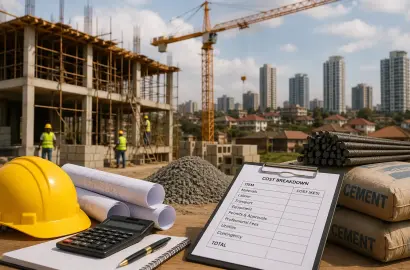
If you've priced out a construction project recently and the numbers came back higher than you expected, you're not imagining it. Kenya's construction costs jumped sharply in the second quarter of 2026 — the steepest quarterly increase in nearly four...

For landowners with capital and a plot in the right location, building rental units from scratch can generate significantly better long-term returns than buying an existing property to rent out — but it's also a considerably more complex, capital-intensive, and...
 Ngong and Ongata Rongai: Nairobi's Southwestern Growth Corridor
  Gated Community Living: Is the Premium Worth It?
  Buying Property Through a SACCO: How It Works
  How to Handle a Dispute With Your Landlord or Tenant
  Kitengela: Why It's Attracting First-Time Buyers
Comments
0 approved commentsNo approved comments yet. Be the first to comment.