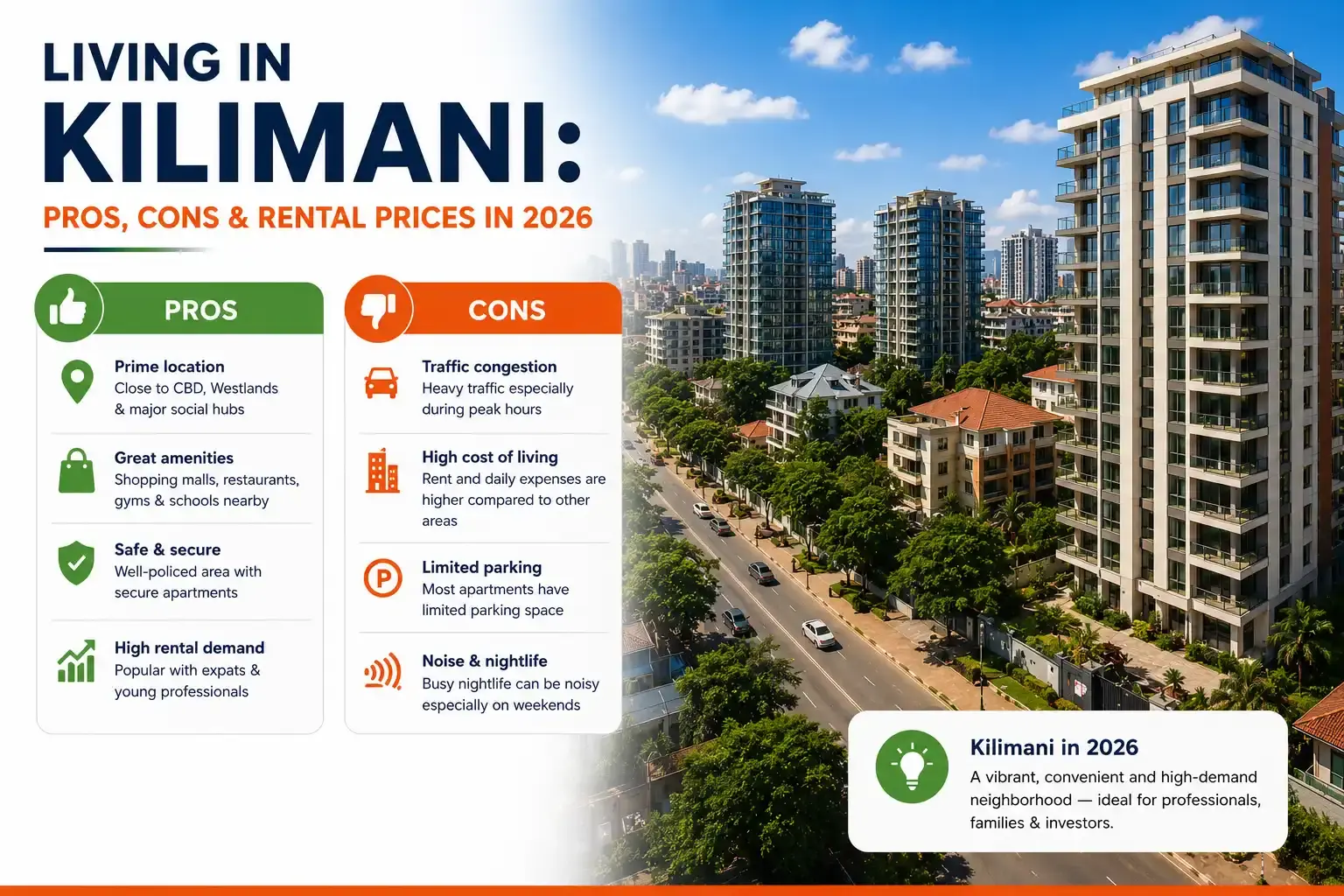
Kilimani is one of Nairobi's most searched-for rental neighbourhoods — and for good reason. Sitting just a few kilometres west of the CBD, bordered by Kileleshwa, Lavington, and Upper Hill, it offers a rare mix of central location, established infrastructure, and a genuinely diverse rental market. But like any high-demand area, Kilimani comes with tradeoffs.
Whether you're a young professional, a small family, or an investor evaluating rental yield potential, here's an honest look at what living in Kilimani actually costs and involves in 2026.
Kilimani Rental Prices in 2026
Kilimani is predominantly an apartment market — standalone houses are rare and tend to be priced well into the tens of millions, so most renters are looking at flats and apartment blocks along the neighbourhood's main roads: Argwings Kodhek Road, Kindaruma Road, Dennis Pritt Road, and Ngong Road.
Rough price bands renters can expect in 2026:
- Studios and bedsitters: from roughly KSh 15,000–30,000/month in older, less modern buildings
- 1-bedroom apartments: typically KSh 30,000–60,000/month, depending on building age and finishes
- 2-bedroom apartments: commonly KSh 50,000–120,000/month
- 3-bedroom apartments: can range from KSh 80,000 up to KSh 200,000/month in premium developments
- Average across all unit types: hovers around KSh 100,000/month, though this masks a wide spread between budget and high-end stock
Prices vary significantly by street and building age — Dennis Pritt, Kindaruma, and Rose Avenue tend to command the higher end, while parts of Ngong Road and Kirichwa Road offer more budget-friendly options in well-maintained older buildings.
For investors, Kilimani has historically delivered gross rental yields in the range of 5–8%, among the stronger returns in Nairobi's established suburbs, with average capital appreciation estimated around 10% annually in recent market analysis.
Pros of Living in Kilimani
1. Unbeatable central location. Kilimani connects directly to Ngong Road, the Southern Bypass, and Uhuru Highway, putting the CBD within roughly 15 minutes outside peak hours, with Upper Hill and Westlands job hubs close by too.
2. A genuinely diverse rental market. From budget bedsitters to luxury 3-bedroom apartments with DSQ, Kilimani has stock for nearly every budget — something increasingly rare in Nairobi's inner suburbs.
3. Strong amenities within walking distance. Yaya Centre and Prestige Plaza cover shopping, banking, and dining, while the Nairobi Arboretum offers a rare pocket of green space in an otherwise dense urban area.
4. Good schooling options nearby. Families have access to institutions like Makini School, Cavina School, and Braeburn without needing to relocate further out.
5. Reliable rental demand. Kilimani's central position and professional tenant base mean landlords typically see shorter vacancy periods compared to more peripheral areas — a plus for both renters (more negotiating options) and investors (steadier occupancy).
Cons of Living in Kilimani
1. Heavy, constant construction. Kilimani remains one of Nairobi's most active construction zones, with new towers going up regularly. Noise and dust near active sites are a real consideration — it's worth visiting a potential home on a weekday to gauge this before signing a lease.
2. Rising prices. As demand has grown, so have rents — Kilimani is no longer the "affordable alternative" to Westlands it once was, and budget options are shrinking, especially for 2- and 3-bedroom units.
3. Parking can be limited. Older buildings in particular may offer minimal or no dedicated parking, which matters if you own a car and are considering a 2- or 3-bedroom unit.
4. Localised flooding risk. Some low-lying sections near Argwings Kodhek Road and Cotton Avenue have experienced surface flooding during heavy rains, though county drainage upgrades have specifically targeted these spots in recent months.
5. Limited space for larger families. Standalone houses with gardens are scarce and expensive in Kilimani — families wanting more outdoor space often look instead to Lavington or Karen.
Who Should Consider Kilimani?
Kilimani tends to suit:
- Young professionals and couples who want walkable amenities and a short commute
- Small families prioritizing school proximity over garden space
- Investors seeking dependable rental yield in an established, high-demand market
- Anyone who wants a central Nairobi address without Westlands' commercial intensity
If you need more space, a garden, or a quieter residential feel, Lavington or Kileleshwa may be a better fit — both are covered in our other neighbourhood guides.
Find Your Next Home in Kilimani with Masion
Kilimani remains one of Nairobi's most consistently in-demand rental markets, and the right unit at the right price does exist — it just takes local knowledge and verified listings to find it.
At Masion, we list vetted rental and sale properties across Kilimani, from budget studios to premium 3-bedroom apartments with DSQ. Browse our current Kilimani listings on masion.co.ke, or speak to one of our agents to find a home that matches your budget and lifestyle.
Explore verified Kilimani listings today at masion.co.ke.
A little more clarity
Frequently asked questions
What does this article cover?
Kilimani is one of Nairobi's most searched-for rental neighbourhoods — and for good reason. Sitting just a few kilometres west of the CBD, bordered by Kileleshwa, Lavington, and Upper Hill, it offers a rare mix of central location, established infrastructure, and a genuinely diverse rental market. But like any high-demand area, Kilimani comes with tradeoffs.
How can I find properties related to my requirements?
Browse the property listings and filter by location, price, and property type. You can also use Request a Property to share your requirements and receive matching suggestions.
How can I ask about a property?
Open the property page to review its details and contact the listing agent using the enquiry options shown there. Confirm availability and arrange a viewing with the agent.

Join the conversation
Comments
Looking for a property?Get help with a request tailored to your location and budget.
No comments yet. Share a thought or ask a question above.