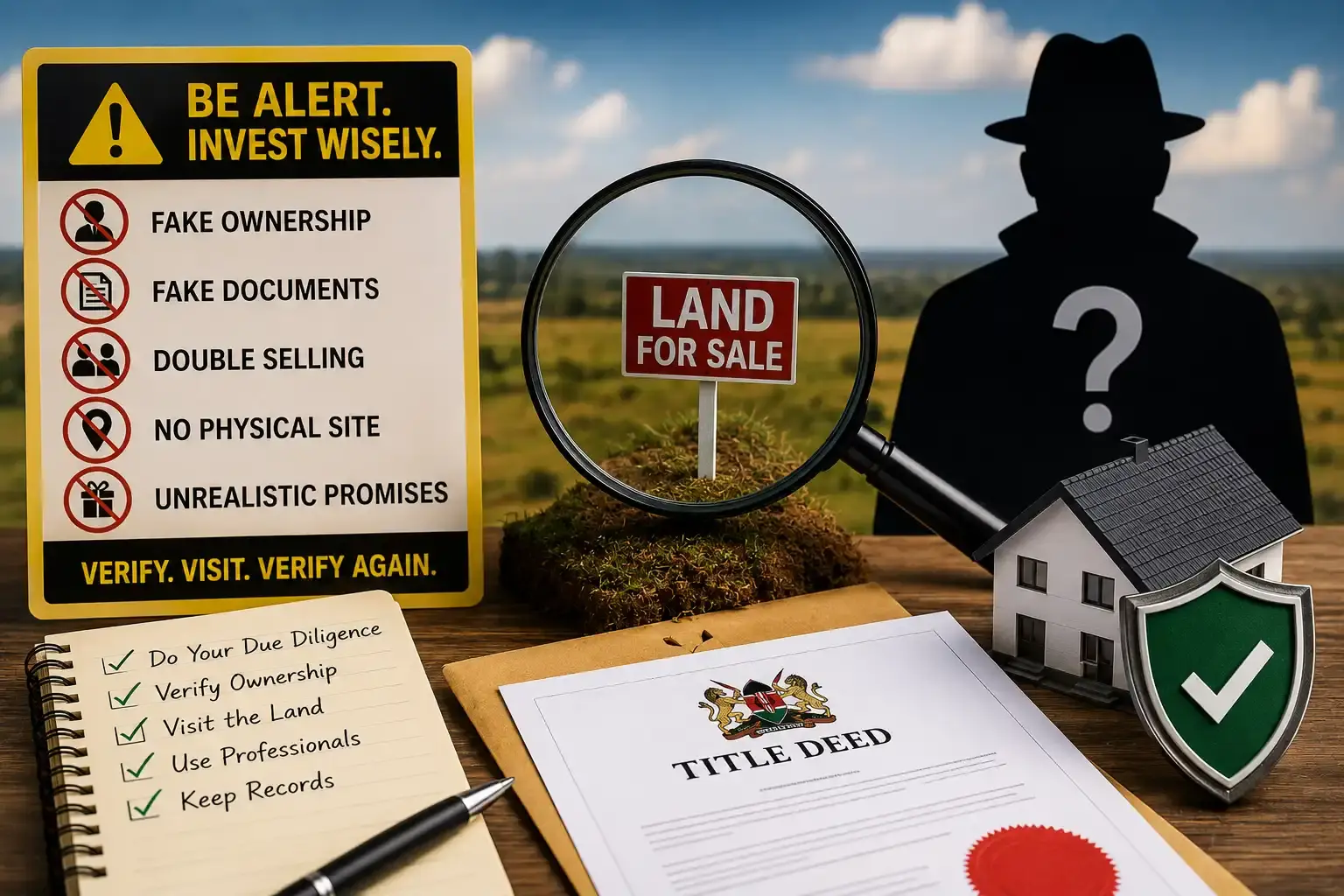
Land banking can be one of the most rewarding long-term investment strategies in Kenya — but it's also a space where fraudsters thrive. Because land banking involves buying property you don't intend to develop or occupy right away, scams often go undetected for months or even years, by which time the fraudster is long gone and the investor is left with a worthless piece of paper.
Understanding the most common scams — and knowing exactly how to protect yourself — is the single best defense against losing your hard-earned money. Here's what every land banking investor in Kenya needs to know.
Why Land Banking Attracts Scammers
Because land banking investors often buy in emerging or peri-urban areas where they don't live and may not visit frequently, fraudsters exploit the distance and reduced oversight. Buyers are also frequently driven by the promise of high future returns, which can cloud judgment and rush due diligence. Scammers count on both factors — physical distance and eagerness — to close deals before red flags are noticed.
1. Fake or Forged Title Deeds
How it works: Fraudsters present a title deed that looks legitimate but is either entirely fabricated or has been altered to misrepresent ownership, size, or land status.
How to avoid it:
- Always conduct an official search at the Ministry of Lands or through the eCitizen platform to confirm the title's authenticity and current registered owner.
- Cross-check the title number, land reference number, and owner's details against official records — never rely solely on a printed copy provided by the seller.
- Work with a licensed advocate to verify the document independently rather than trusting the seller's paperwork at face value.
2. Selling Land That Doesn't Belong to the Seller
How it works: A con artist poses as the landowner (sometimes using forged identification) and sells land they have no legal right to, often targeting absentee owners' land or disputed family land.
How to avoid it:
- Verify the seller's identity against the registered owner's details on the title deed.
- Request original identification documents and cross-reference them with the Ministry of Lands records.
- If the land is family or inherited property, confirm that all rightful heirs have consented to the sale — a single family member cannot legally sell jointly-owned land alone.
3. Selling the Same Plot to Multiple Buyers
How it works: A fraudulent seller collects deposits or full payments from several unsuspecting buyers for the same piece of land, disappearing once the money is collected.
How to avoid it:
- Insist on completing the official transfer process promptly after purchase, rather than leaving the land registered in the seller's name for an extended period.
- Conduct a fresh search immediately before finalizing payment, as titles can change hands (or be fraudulently sold) between your initial search and the actual transaction date.
- Avoid making full payment before the transfer process is legally underway.
4. Non-Existent or "Paper" Plots
How it works: Scammers sell land based on a survey plan or subdivision that hasn't actually been registered or approved — meaning the specific plot you're buying doesn't legally exist yet, or ever.
How to avoid it:
- Confirm that the subdivision has been officially approved and registered with the relevant county and Ministry of Lands offices.
- Visit the physical site and verify that beacons are placed and match the survey plan.
- Avoid buying plots that are only described on a promotional map or brochure without corresponding official documentation.
5. Land Located on Riparian, Road Reserve, or Government Land
How it works: Land is sold without disclosing that it falls on a riparian reserve (near rivers/water bodies), a road reserve, or other restricted government land — making it illegal to develop and vulnerable to future demolition or repossession.
How to avoid it:
- Request a land status report or conduct due diligence through the county government and National Land Commission to confirm the land isn't classified as reserved or restricted.
- Be cautious of unusually low prices for land in seemingly desirable locations — this can be a red flag that the land carries legal restrictions.
6. Encumbered Land (Existing Loans, Caveats, or Disputes)
How it works: The land you're buying already has an existing loan against it (used as bank collateral), a caveat (legal notice of a dispute), or is subject to ongoing litigation — all of which can jeopardize your ownership even after purchase.
How to avoid it:
- A thorough official search will reveal any caveats, charges, or encumbrances registered against the title.
- Do not proceed with a purchase if the search reveals any unresolved encumbrances, until they are formally cleared and confirmed in writing.
7. Fraudulent "Group" or "Chama" Land Schemes
How it works: Fraudulent land-buying companies or individuals collect money from investment groups (chamas) promising discounted group land deals, only to disappear or deliver land far different from what was promised.
How to avoid it:
- Verify that the company or individual organizing the group purchase is registered and has a verifiable track record.
- Insist on individual title processing for each member rather than a single collective document that's harder to trace and enforce.
- Request to see the mother title and confirm the subdivision plan before contributing funds.
Red Flags That Should Make You Pause
- Pressure to pay quickly to "secure a limited-time discount"
- Reluctance from the seller to allow an independent search or site visit
- Prices significantly below market rate for the area
- Missing or inconsistent documentation
- Sellers who avoid formal, written agreements in favor of informal cash deals
Your Due Diligence Checklist Before Buying
- Conduct an official Ministry of Lands search on the title
- Verify seller identity against title deed records
- Confirm subdivision approval (for newly subdivided plots)
- Visit the physical site and confirm beacon placement
- Check for encumbrances, caveats, or existing loans
- Confirm the land isn't on riparian, road reserve, or restricted government land
- Engage a licensed advocate to handle the transaction
- Complete the transfer process promptly after purchase
Land banking remains one of the most effective long-term wealth-building strategies available in Kenya — but only when approached with diligence and caution. The scams outlined above thrive on urgency, distance, and trust placed in the wrong hands. By slowing down, verifying every document independently, and working with reputable professionals, you dramatically reduce your risk of falling victim to fraud.
At Masion, every plot we offer undergoes rigorous due diligence before it ever reaches a client — because your peace of mind matters as much as your investment returns. Get in touch with our team to explore verified, secure land banking opportunities.
Continue building your investment knowledge with our guides on due diligence checklists and understanding land rates, ground rent, and hidden costs.
A little more clarity
Frequently asked questions
What does this article cover?
Land banking can be one of the most rewarding long-term investment strategies in Kenya — but it's also a space where fraudsters thrive. Because land banking involves buying property you don't intend to develop or occupy right away, scams often go undetected for months or even years, by which time the fraudster is long gone and the investor is left with a worthless piece of paper.
How can I find properties related to my requirements?
Browse the property listings and filter by location, price, and property type. You can also use Request a Property to share your requirements and receive matching suggestions.
How can I ask about a property?
Open the property page to review its details and contact the listing agent using the enquiry options shown there. Confirm availability and arrange a viewing with the agent.


Join the conversation
Comments
Looking for a property?Get help with a request tailored to your location and budget.
No comments yet. Share a thought or ask a question above.