Kenya's interest rate environment has shifted meaningfully over the past year. After the double-digit Central Bank Rate levels seen through 2024 and much of 2025, the Central Bank of Kenya cut its benchmark rate to 8.75% in February 2026 — its tenth consecutive rate cut. For anyone with an existing mortgage, or considering taking one out, this shift has real, practical implications. Here's what's actually changed, and what it means for your monthly payments and buying power.
Understanding the Current Rate Environment
The Central Bank Rate (CBR) is the benchmark rate that influences what commercial banks charge on loans, including mortgages. As of February 2026, the CBR sits at 8.75%, down from the considerably higher levels of the preceding two years — a shift driven by the Central Bank's efforts to stimulate lending and economic activity while inflation has remained comfortably within target (around 4.4% in early 2026).
Current mortgage rates vary meaningfully by lender and product, ranging from around 8.99% on the most competitive promotional offers to 18% at the higher end, depending on the bank, loan type, and borrower risk profile. This is a considerably wider range than it might first appear — the specific rate you're offered depends heavily on your credit profile, the lender, and whether you're comparing fixed or variable products.
What Falling Rates Mean for Borrowers
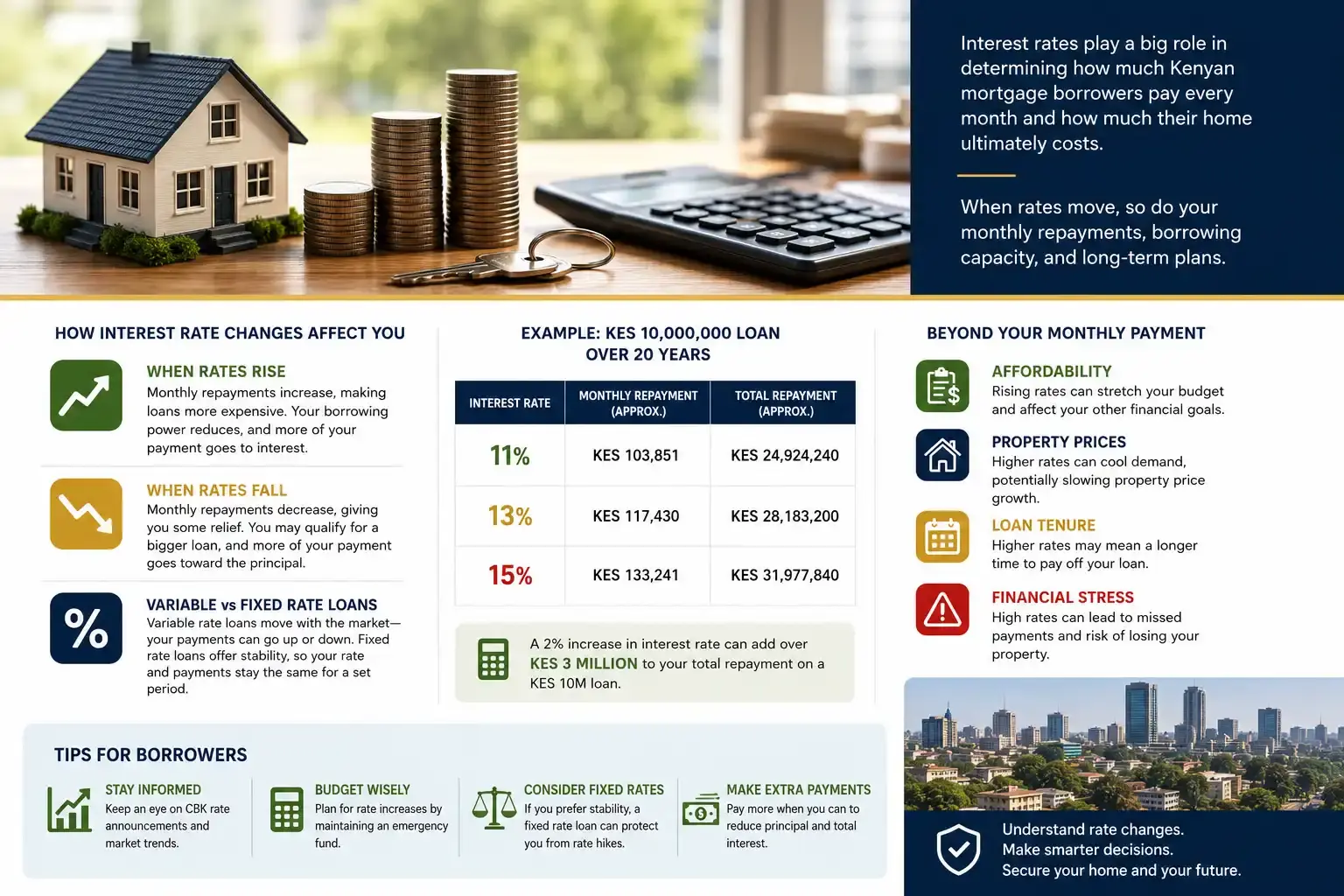
Lower Monthly Repayments
When banks pass along CBR reductions to their lending rates, existing variable-rate mortgage holders can see their monthly repayments decrease — freeing up cash flow without any change to the loan itself.
Increased Borrowing Capacity
Lower rates mean a given monthly payment covers a larger loan amount than it would have under higher rates — effectively increasing how much property a borrower can qualify for at the same monthly budget. This is part of why 2026 has been described by some market commentators as more favorable for buyers than the preceding two years.
Renewed Market Activity
Lower borrowing costs tend to draw hesitant buyers off the sidelines, and there has been renewed optimism among both consumers and private-sector businesses following the rate cuts — a dynamic worth watching, since increased buyer activity can, over time, put upward pressure on property prices in high-demand areas.
The Important Catch: Most Kenyan Mortgages Are Variable Rate
This is the detail borrowers most often overlook. The vast majority of Kenyan mortgages are variable rate, meaning your interest rate — and therefore your monthly payment — moves with the CBR and broader lending rate environment. Today's lower rates are genuinely attractive, but they aren't guaranteed to stay this low.
If rates rise again in the future (whether due to inflation pressures or a change in monetary policy direction), variable-rate borrowers will see their monthly payments increase correspondingly — sometimes significantly, depending on the size of the move.
Fixed vs Variable: What to Consider Right Now
Fixed-rate mortgages lock in your interest rate for a set period, protecting you from future rate increases in exchange for potentially less benefit if rates continue falling. Given the currently attractive rate environment — including some genuinely competitive promotional fixed offers — locking in a fixed rate now can make sense for borrowers who value payment certainty and want protection against a future rate increase.
Variable-rate mortgages track the broader rate environment, meaning your payments could decrease further if rates continue falling, but also increase if the trend reverses. This suits borrowers comfortable with some payment fluctuation, or those who plan to refinance or pay off the loan within a few years regardless of rate movements.
A Practical Affordability Test
Financial analysts commonly recommend stress-testing your ability to afford a mortgage against a meaningful rate increase — not just today's attractive rate. A useful practical exercise: calculate what your monthly payment would look like if rates rose by 2 percentage points from today's level, and honestly assess whether that payment would still be manageable. If the answer is no, it's worth being cautious about over-extending based purely on current, historically favorable conditions.
What This Means If You're Buying Now
- Compare rates carefully across multiple lenders — the current spread between the most competitive and least competitive mortgage offers is unusually wide, making comparison shopping genuinely worthwhile
- Ask for the full APR, not just the headline rate — fees and charges can meaningfully affect the true cost of borrowing beyond the advertised interest rate
- Consider locking in a fixed rate if payment certainty matters to you, particularly given some currently competitive promotional offers
- Don't assume today's low rates are permanent — factor in a reasonable buffer for potential future increases when assessing what you can comfortably afford
- Remember real estate is illiquid — even in a favorable rate environment, be prepared to hold a property for the medium to long term rather than assuming quick resale flexibility
What This Means If You Already Have a Mortgage
If you're on a variable-rate mortgage, it's worth checking with your bank on how recent CBR reductions have (or haven't) been reflected in your current rate — passthrough isn't always immediate or complete. If you're on an older, higher fixed-rate mortgage, it may be worth exploring refinancing options now that competitive rates are more widely available, though refinancing costs should be weighed against the potential savings.
The Bigger Picture
Kenya's current rate environment — falling from double-digit levels through much of 2024 and 2025 down to 8.75% by early 2026 — represents a genuinely notable shift for the property market. Combined with resilient GDP growth (projected around 5.5% for 2026) and inflation comfortably within target, conditions currently favor buyers more than they have in recent years. But rate environments change, and any borrowing decision should be made with a clear-eyed view of both today's opportunity and tomorrow's risk.
Explore Financing-Ready Properties with Masion
Whether you're taking advantage of today's more favorable rate environment or planning ahead for a future purchase, Masion lists verified properties across Kenya and can help connect you with financing guidance to make an informed decision.
Browse properties and financing options at masion.co.ke.
This article is for general informational purposes and does not constitute financial advice. Always consult a licensed financial advisor or your bank directly for guidance specific to your situation, and verify current rates directly with lenders before applying.
FAQs
1. What is Kenya's current Central Bank Rate? As of February 2026, the Central Bank Rate stands at 8.75%, following ten consecutive rate cuts from the considerably higher levels seen through 2024 and much of 2025.
2. Will my mortgage payments automatically decrease if the CBR falls? If you're on a variable-rate mortgage, your payments should decrease as your bank adjusts rates linked to the CBR, though passthrough timing and completeness can vary by lender — it's worth confirming directly with your bank.
3. Should I choose a fixed or variable mortgage rate right now? It depends on your risk tolerance and plans. Fixed rates offer payment certainty and protection against future increases, which can be attractive given some currently competitive promotional offers, while variable rates offer potential further savings if rates continue falling, with the risk of increases if they don't.
4. How much could my mortgage payment increase if rates rise again? This depends on your specific loan size and terms, but a common recommendation is to stress-test your affordability against a 2 percentage point rate increase from today's level, to confirm you could still comfortably manage payments if rates rise.
5. Are current mortgage rates in Kenya the same across all banks? No — rates vary considerably, from around 8.99% on the most competitive promotional offers to 18% at the higher end, depending on the lender, product, and borrower risk profile, making it worth comparing multiple lenders directly.
6. Is now a good time to buy property in Kenya given current interest rates? Current conditions are generally viewed as more favorable for buyers than recent years, given lower borrowing costs and increased purchasing power, though any decision should account for the possibility of future rate increases and real estate's relatively illiquid nature.
Related posts:

Gated communities have become one of the defining features of Kenya's growing satellite towns and premium suburbs alike — offering shared security, amenities, and a managed environment in exchange for a genuine price premium over comparable standalone properties.

For many Kenyans, the biggest obstacle to owning property isn't willingness — it's raising a lump sum upfront. SACCOs (Savings and Credit Cooperative Organizations) have become one of the most accessible ways around this problem, offering both structured savings-based housing...
 Ngong and Ongata Rongai: Nairobi's Southwestern Growth Corridor
  Gated Community Living: Is the Premium Worth It?
  Buying Property Through a SACCO: How It Works
  How to Handle a Dispute With Your Landlord or Tenant
  Kitengela: Why It's Attracting First-Time Buyers
Comments
0 approved commentsNo approved comments yet. Be the first to comment.